Reverse Engineer Anything (REA): what it does, and what SyncupHUB already includes
REA, the viral MCP server, lets AI agents reverse engineer apps and binaries. For your own code, SyncupHUB already includes evidence-linked reverse engineering.
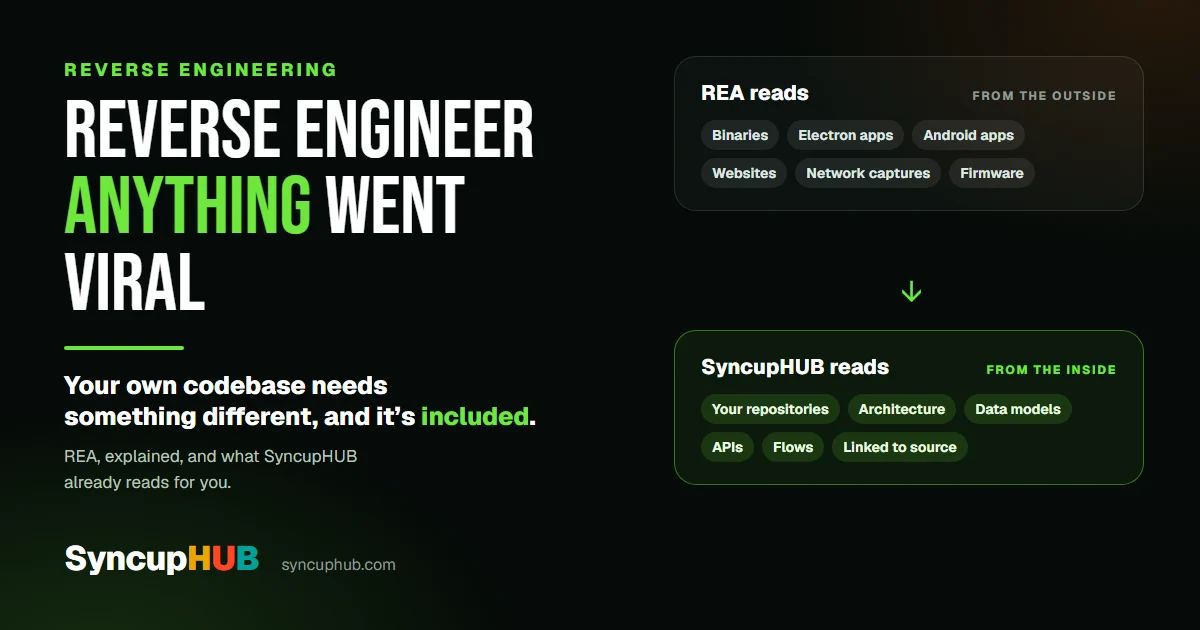
Disclosure. Published by SyncupHUB. What we say about REA comes from its own README and the coverage linked below, read on 14 October 2026; open-source tools change quickly, so check the repository for the current state.
Short answer
Do I need REA to reverse engineer my own codebase?
Usually not. REA, Reverse Engineer Anything, connects AI agents to tools like Ghidra and IDA to read compiled software from the outside. To understand source code you already own, SyncupHUB’s AI Documentation reads the repository into architecture, data models, APIs and flows, linked to source, included in every plan.
A GitHub repository called REA, short for Reverse Engineer Anything, has become the most-starred project under GitHub’s reverse-engineering topic, ahead of Ghidra.
It promises what the name says: point an AI coding agent at a piece of software and have it work out how that software works. It is a genuinely useful tool. It is also aimed at a different problem from the one most delivery teams actually have.
What REA actually is
REA is an MCP server and a command-line tool. Its README describes it as “one MCP for reverse engineering across binaries, applications, and runtime behavior” (REA on GitHub).
It does not bring a new way of reverse engineering. It connects the AI agent you already use to the tools reverse engineers already use, and lets the agent drive them:
- Agents: Claude Code, Codex, Cursor, Gemini CLI and Grok Build, set up with one command, npx rea-agents setup
- Native tools: Ghidra, IDA, Hopper, objdump and Rizin
- Android: JADX, Apktool, JEB and adb
- Everything else: GDB, Binwalk, TShark, sigrok and more
The agent inspects a target, traces the code that matters, and comes back with pseudocode, symbols, routes and call references, plus findings with their evidence and the unknowns it could not resolve. From there it can explain the behaviour, or write and test its own implementation.
When we checked on 14 October 2026 it had about 229,000 stars, the most of any repository under GitHub’s reverse-engineering topic, ahead of Ghidra’s 87,000.
What it reads
REA is built for software you do not have the source of. Its README lists, among others:
- Native binaries — ELF, PE and Mach-O, including Go and Rust builds — plus WebAssembly and EVM bytecode
- JavaScript and Electron apps, including packed ASAR archives
- Websites, observed through a Chrome-family browser
- Saved network captures (HAR, Fiddler, mitmdump) and packet captures
- .NET assemblies, Android apps and Android devices
- Firmware, Flutter apps, SQLite databases and recorded Linux crashes
Its own code is MIT-licensed. The commercial tools it can drive are not: IDA Pro, Hopper and JEB need their own licences, and REA grants none. Analysis runs locally, but the agent’s model provider sees what the agent sends it.
What the early tests show
The coverage has been enthusiastic, and the evidence more modest. In MindStudio’s test, an agent rebuilding the Mac Preview app with REA was not faster than the same agent without it — the plain agent finished first, and the gap between the two was narrow (MindStudio).
That is not a mark against REA. It connects good tools to capable agents, and on complex, unfamiliar binaries that should matter more than it does on a simple viewer app. It is a reminder that stars measure attention, not results.
The README is also clear about where it may be used: lawful research, education, interoperability, software preservation, and software you own or are authorised to examine. Cracked copies, stolen keys and licence bypasses are explicitly out.
Two kinds of reverse engineering
“Reverse engineering” covers two jobs that rarely meet:
- From the outside. You have a binary, an app or a website and no source code. You want to know how it behaves — for interoperability, security research or preservation. This is REA’s ground.
- From the inside. You own the source code, but nobody left in the building understands it. You need its architecture, data models, APIs and flows before you can change, migrate or hand it over.
Most delivery teams live with the second. It arrives through attrition, an acquisition or a migration, and it is the problem we wrote about in the only person who understood it has left.
Most teams do not need to decompile someone else’s app. They need to understand their own.
What SyncupHUB already includes
Reverse engineering from the inside is already part of SyncupHUB, in AI Documentation. Point it at a repository — a local folder or a Git repository — and it reads the code into:
- A Reverse Engineering view that recovers product knowledge, not just a code inventory: it starts from the BRD and prepares one consolidated assessment for review
- Overview and architecture, with a C4 model of the system and an application map
- Data models, read from the schema and the code that touches it
- An API reference, flow diagrams and code intelligence
- How the architecture has evolved, and full documentation in one place
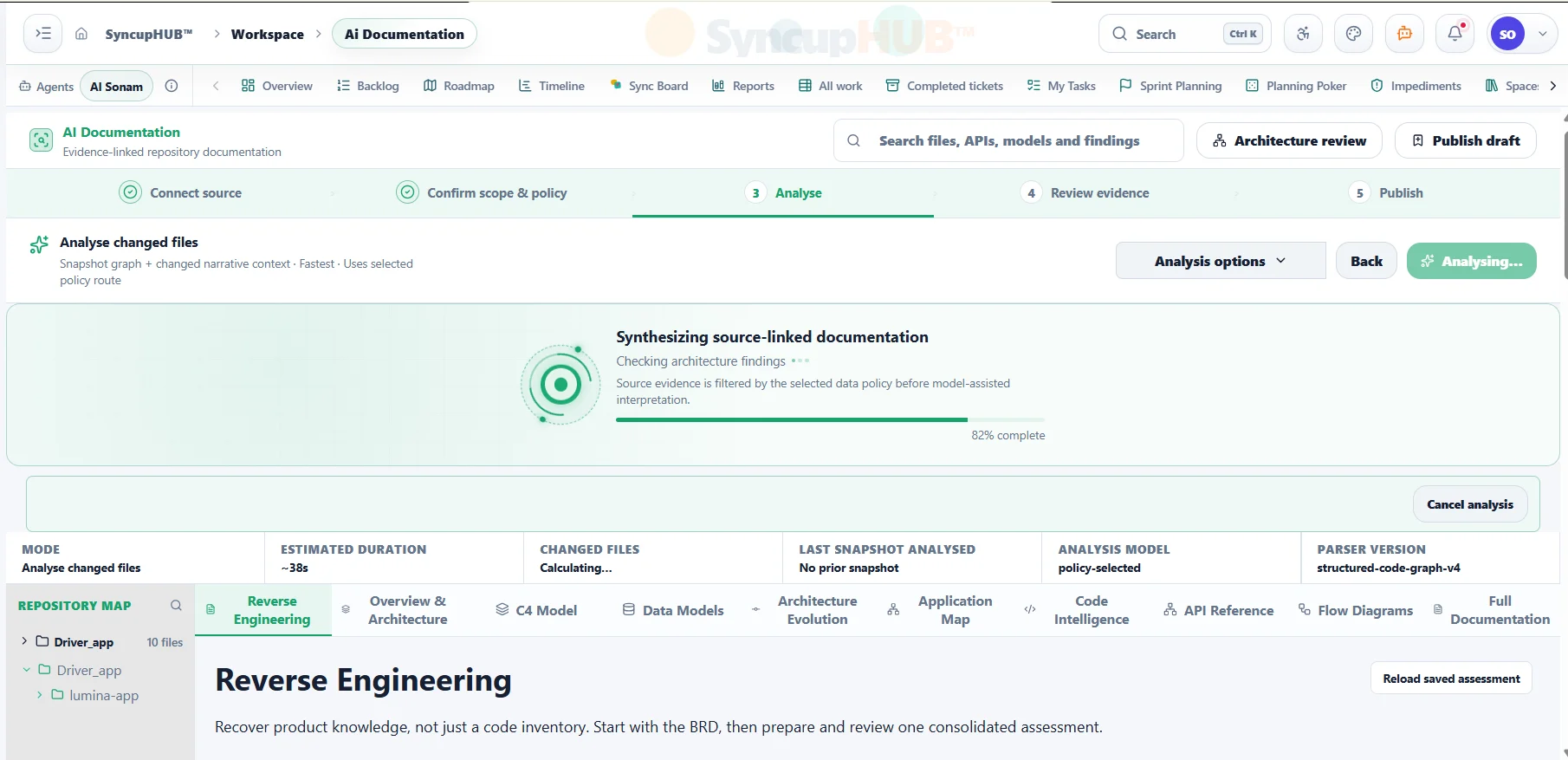
Three things make it fit for delivery work rather than a demo:
- Evidence, not a plausible summary. A source graph underneath does the reading; the model explains what the graph found. Every finding links to the files it came from.
- Nothing publishes itself. Output is marked AI-generated and review required. A person reviews it, then publishes it to a Document Space with an owner and named reviewers.
- It closes the loop to requirements. The code is read back into candidate business journeys that a person confirms, and findings link to remediation stories and architecture decisions.
Included, not an add-on
AI Documentation is part of the platform, and every plan includes the full platform. Cloud is free for the first month, then $7.65 per user per month; self-hosting has no licence fee. In-tenant AI use is unmetered, so reading a large repository does not run up a per-query bill. If your administrator approves an external provider, such as the OpenAI or Claude API, that provider bills on its own terms.
REA and SyncupHUB side by side
| Compared | REA | SyncupHUB AI Documentation |
|---|---|---|
| Reads | Compiled software and running apps, from the outside | Source repositories you own, from the inside |
| Output | Pseudocode, symbols, routes, findings with evidence | Architecture, data models, APIs, flows, linked to source |
| Runs | Locally, driven by your AI coding agent | In your SyncupHUB tenant, under your AI provider policy |
| Review | Up to you | Marked review-required; published by a person, with owners |
| Cost | MIT-licensed; some tools and the agent’s model are paid | Included in every plan; Cloud free for a month |
| Best for | Interoperability, security research, preservation | Legacy modernisation, migration, knowledge transfer |
Which one do you need?
Use REA when the thing you need to understand is compiled software you are authorised to examine — a vendor binary you must interoperate with, an app you are researching, firmware you are preserving.
Use SyncupHUB when it is your own system: a codebase you have inherited, a platform you are about to migrate, a service whose author has left. You get the reading, the evidence and the review in the same place your delivery already runs.
Plenty of teams will want both. They answer different questions.
Frequently asked questions
What is Reverse Engineer Anything (REA)?
REA is an open-source MCP server and command-line tool that connects AI coding agents, such as Claude Code, Codex, Cursor and Gemini CLI, to reverse engineering tools like Ghidra, IDA and JADX. It inspects compiled software and running apps and returns findings with their evidence.
Is REA free?
REA’s own code is MIT-licensed. Some of the tools it drives, such as IDA Pro, Hopper and JEB, need their own licences, and the AI agent you run it through is billed by its model provider.
What can REA reverse engineer?
Native binaries (ELF, PE and Mach-O, including Go and Rust), WebAssembly, JavaScript and Electron apps, websites through a Chrome-family browser, saved network and packet captures, .NET assemblies, Android apps and devices, firmware, Flutter apps and SQLite databases, among others.
Does SyncupHUB do what REA does?
Not on the same targets. REA reads compiled software and running apps from the outside. SyncupHUB’s AI Documentation reads the source repositories you own and turns them into architecture, data models, APIs and flows, each finding linked to its source and reviewed by a person before it is published.
Does reverse engineering in SyncupHUB cost extra?
No. AI Documentation is part of the platform, and every plan includes the full platform. Cloud is free for the first month, then $7.65 per user per month; self-hosting has no licence fee. In-tenant AI use is unmetered; an external AI provider you approve bills on its own terms.
Is it legal to reverse engineer software?
It depends on where you are, the software’s licence and your purpose, so check with your own counsel. REA’s README limits it to lawful research, education, interoperability, preservation, and software you own or are authorised to examine. Reading your own source code is the simplest case.
A viral tool can read someone else’s app. A codebase you cannot explain is still somebody else’s problem.
Reading your own systems, with every claim traced to a line, is already in your plan.
Features in this article
SyncupHUB runs this inside your own tenant — a delivery model that reads the signal as it forms, with an agent for every role.
Keep reading
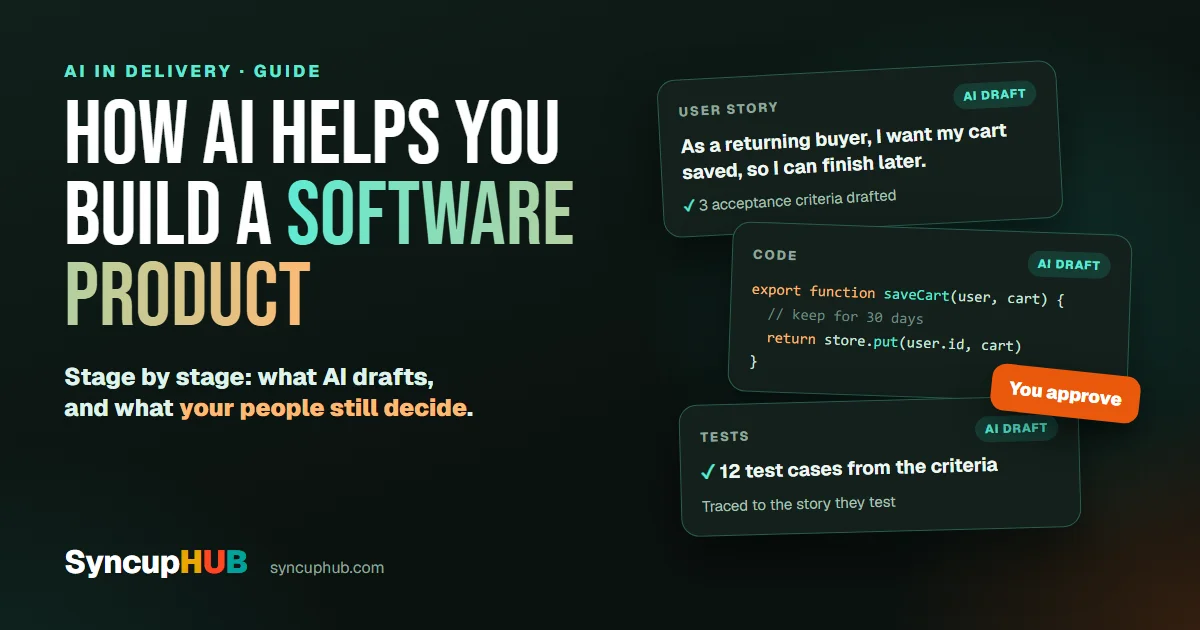
How AI helps you build a software product, stage by stage
Where AI genuinely helps in software product development, from discovery and requirements to code, tests and release, and what your people should still own.
AI software that actually saves you time in 2027
The AI tools that genuinely save hours, from meeting notes to code, task by task, and a simple test for spotting the ones that only add work.