AI and Tools Marketplace
The AI models and delivery tools your teams may use, from in-tenant models to the OpenAI and Claude APIs, each approved by an administrator.
Learn moreFewer tokens. More delivery.
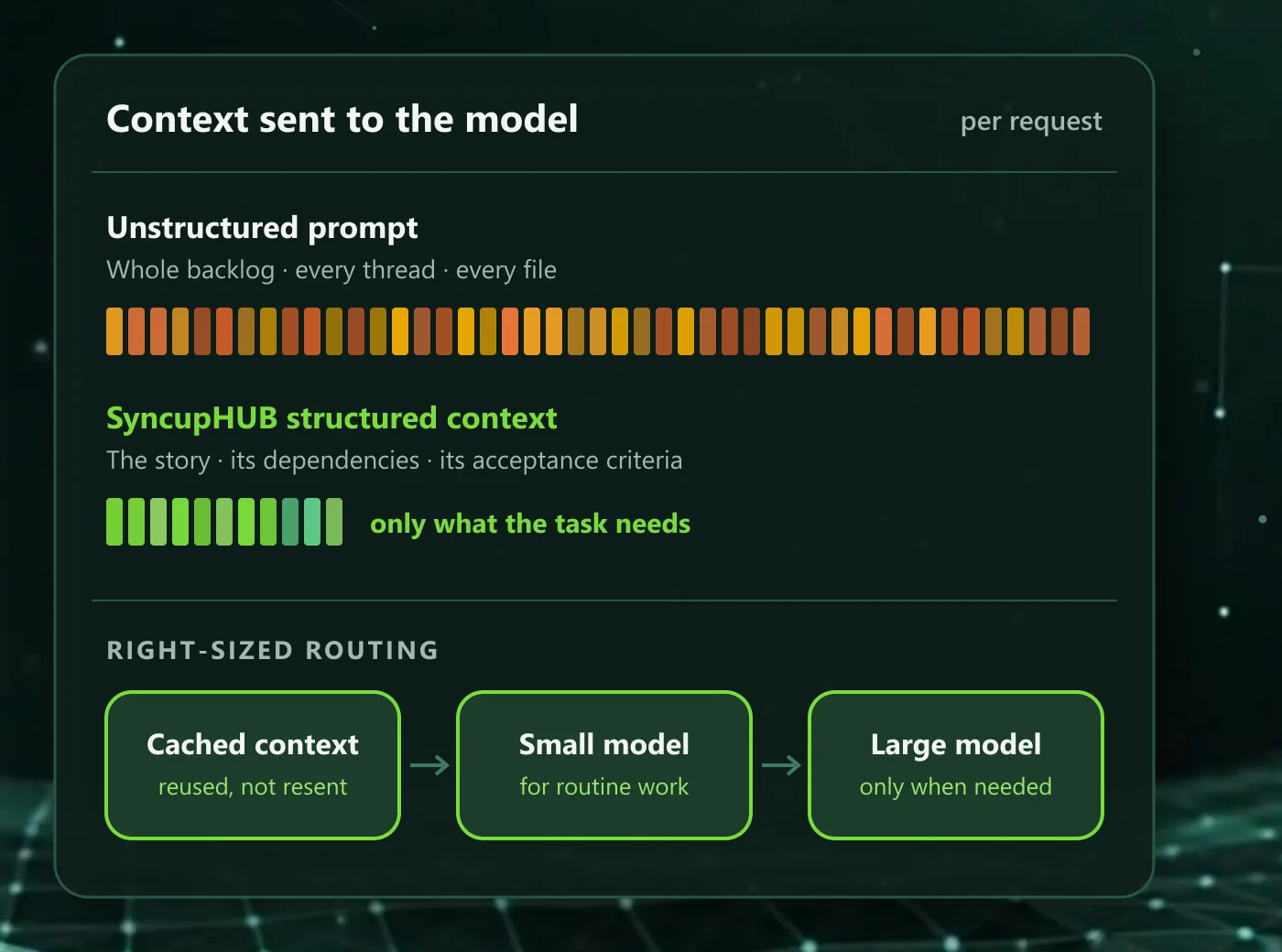
Token efficiency is how SyncupHUB keeps AI cost tied to output rather than prompt size. Because the delivery model is structured, an agent sends only the context a task needs, such as the story, its dependencies and its acceptance criteria, instead of a whole backlog. Routine work runs on small models and cached context, and in-tenant usage is unmetered.
The hierarchy already knows which story, dependencies and criteria a task concerns, so the request carries those and nothing else.
Context that has not changed is served from cache instead of being sent to a model again.
Small models handle routine work, and larger ones are used only for the rare task that needs them.
Private models run on your infrastructure, so in-tenant usage is not metered per query and there is no per-seat AI upcharge.
Stated plainly, before a demo does.
By sending less, and sending it to the right model. The structured delivery model lets an agent send only the context a task needs instead of a whole backlog, unchanged context is reused from cache, and routine work goes to small models.
Not inside your tenant. Private models run on your infrastructure, so in-tenant usage is unmetered and there is no per-seat AI upcharge. If you approve an external provider, that provider bills on its own terms.
Matching each task to the smallest model that does it well. Routine work such as grooming runs on small in-tenant models, and larger models are kept for the rare task that needs them, so cost follows the difficulty of the work.
It depends on your models, your providers and how your teams work, so we do not quote a single figure. What we can state is the mechanism: less context per request, reuse instead of resending, and smaller models for routine work.
The AI models and delivery tools your teams may use, from in-tenant models to the OpenAI and Claude APIs, each approved by an administrator.
Learn moreSeventeen persona agents and 59 sub-agents, all reading the same delivery model.
Learn morePortfolio health, programmes at risk and the decisions waiting on you, read from the live delivery.
Learn moreA 30-minute walkthrough on your delivery model, not a generic demo.