Requirement to Code Traceability
Follow a requirement to the code that shipped it, and recover requirements from code that exists.
Learn moreTest cases drafted from your acceptance criteria. Approved by your QA lead.
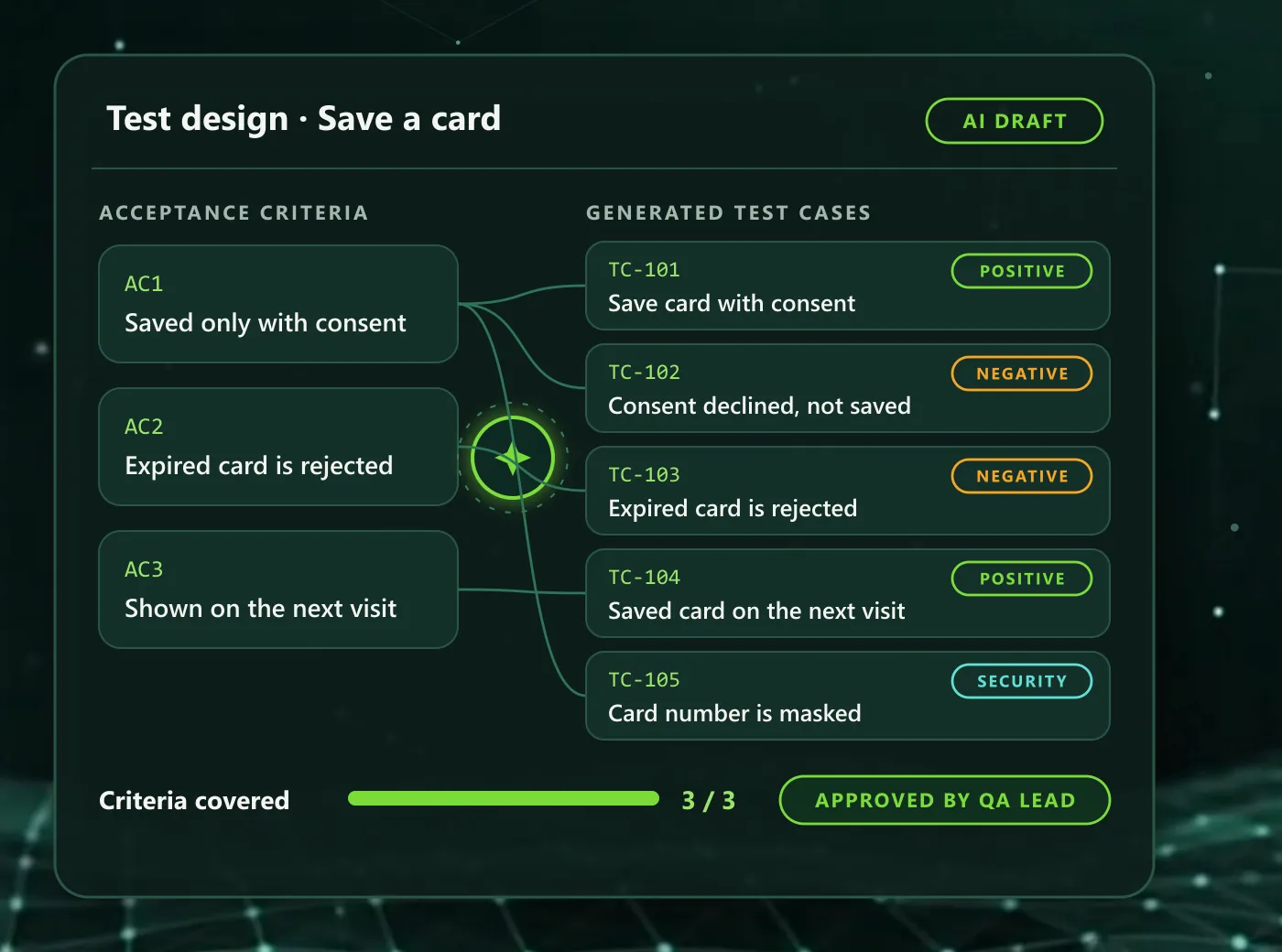
QA Intelligence is SyncupHUB’s test management and quality layer. AI drafts test cases from a story’s acceptance criteria, covering positive, negative and security cases, and your QA lead reviews and approves them. Every case traces back to its requirement, so coverage of committed stories, quality gates and release readiness rest on evidence rather than a pass rate.
Each story’s acceptance criteria are the source for its tests, so a test exists because a requirement asked for it.
Test cases are drafted for each criterion, from the expected path to the failure cases and security checks, as proposals rather than finished tests.
Your QA lead edits, accepts or rejects each draft. Approved versions are protected, and a later change creates a new version.
Executions, results and linked defects roll up into coverage for committed stories and into quality gates, whose decisions are recorded for the release.
Stated plainly, before a demo does.
Yes, as drafts. AI drafts test cases from a story’s acceptance criteria, including positive, negative and security cases, and each one links back to the criterion it covers. A QA lead reviews and approves them before they join the test repository.
Drafts appear for review, and a QA lead edits, accepts or rejects each one. Approved test versions are protected: changing an approved test creates a new version rather than overwriting the one that was signed off.
It links every test to the requirement it verifies. In SyncupHUB you can open a requirement and see its tests and their latest results, and see which committed stories still have no coverage before a release.
No. It manages test design, approval, execution records, coverage and quality gates, and imports results from your automation. Automation import and external evidence storage need configuring for your tools.
Follow a requirement to the code that shipped it, and recover requirements from code that exists.
Learn moreSeventeen persona agents and 59 sub-agents, all reading the same delivery model.
Learn moreDocuments with comments, approvals and version history, kept next to the stories they govern.
Learn moreA 30-minute walkthrough on your delivery model, not a generic demo.