Move from enterprise intent to evidence-backed outcomes.
01 / Product and agile delivery
Give every team a clear path from idea to release.
Capture demand, shape product work, plan realistic sprints, and preserve delivery evidence in the same workspace. Teams move faster because context remains attached to the work.
Epics, features, stories, boards, and grooming
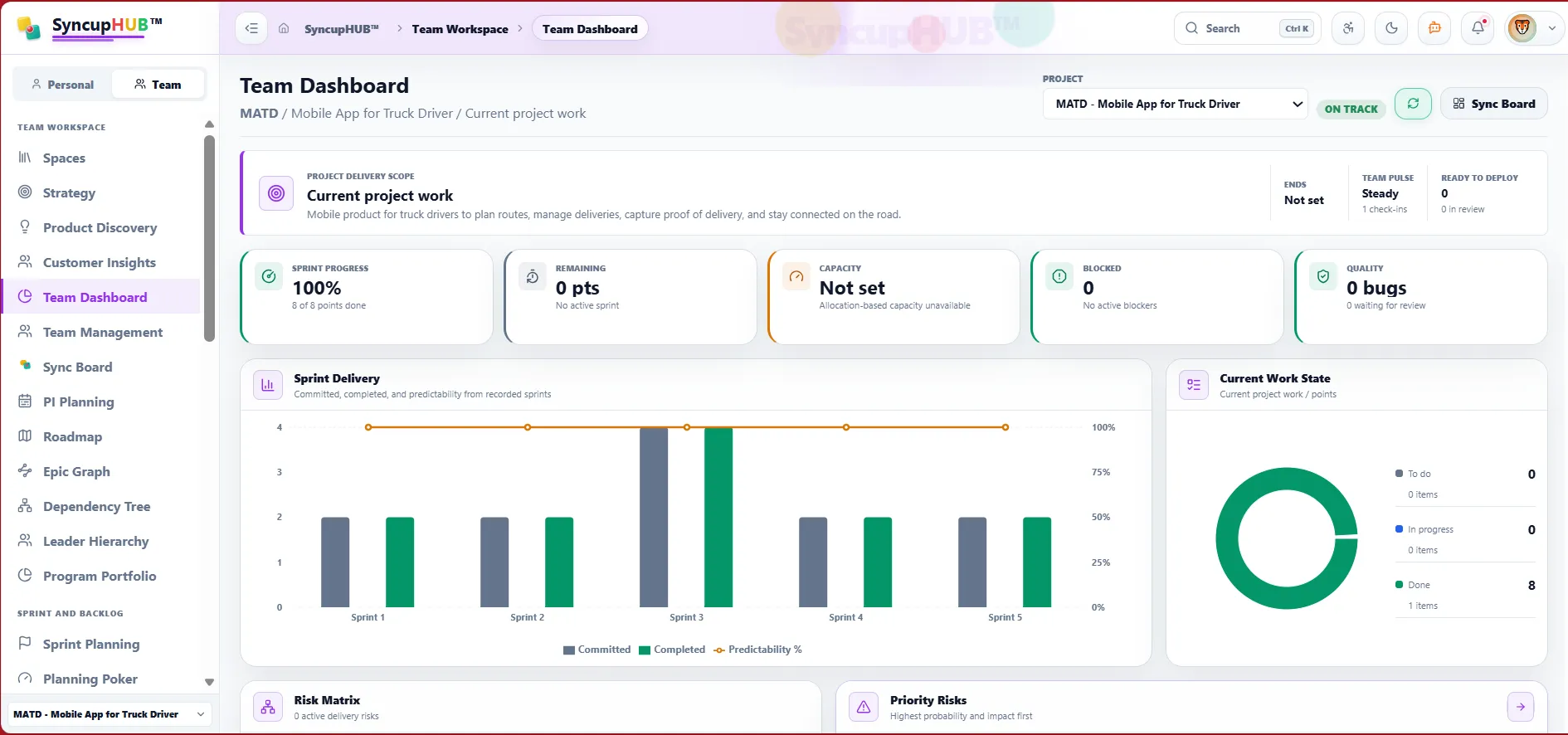
Capacity, burndown, blockers, and retrospectives
Release tracking with deployment evidence
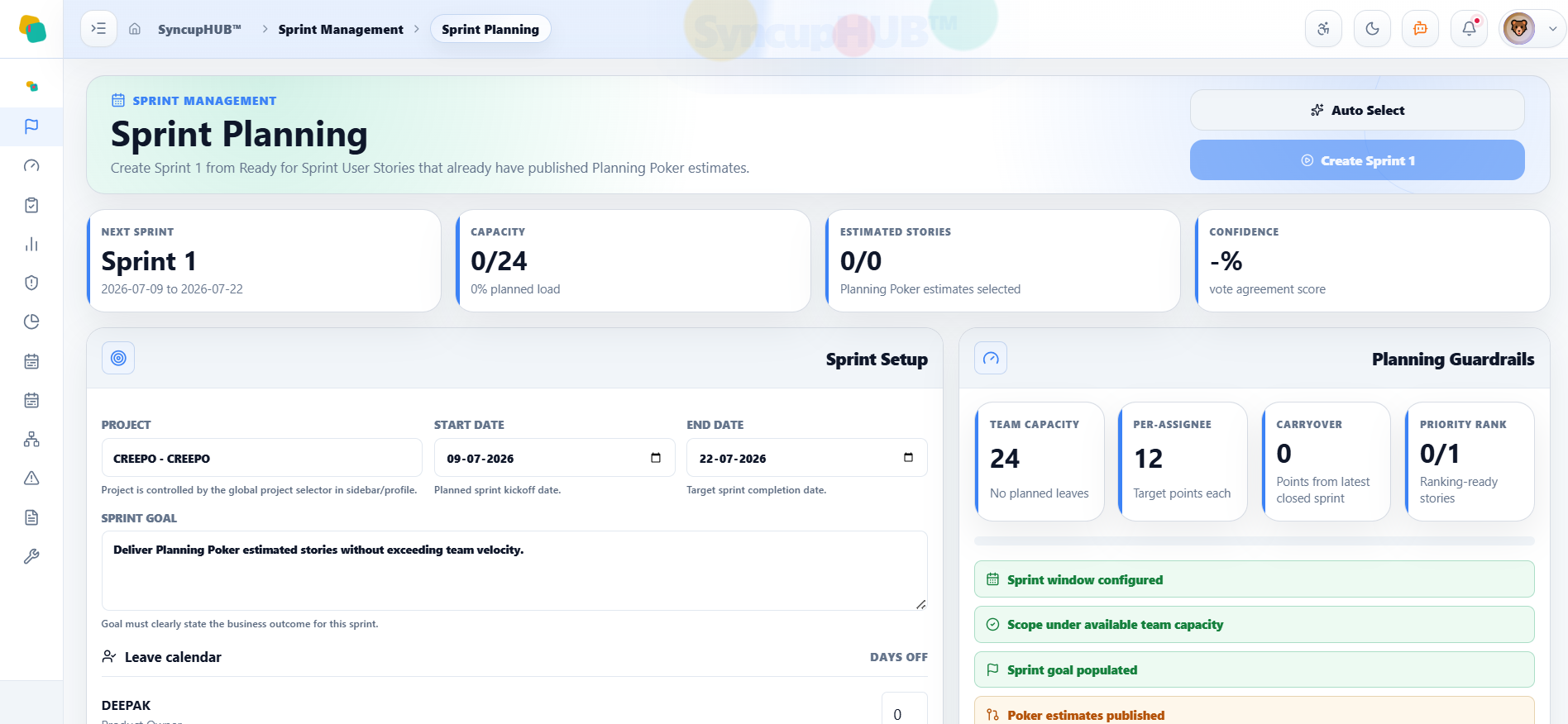
Sprint planning and Scrum workspace
02 / Program and portfolio governance
Make complex delivery legible to leadership.
Connect cross-project milestones, budgets, risks, dependencies, approvals, and workforce contribution so leaders can intervene before issues become missed outcomes.
Enterprise health and strategic outcomes
Financial and capacity exposure
Decision queues and release confidence
Executive and program command view
03 / Knowledge and intelligence
Turn delivery evidence into reusable intelligence.
Analyze repositories, map architecture and dependencies, document verified evidence, and collaborate visually without separating knowledge from execution.
Architecture, API, schema, and code intelligence
Knowledge spaces and visual canvas collaboration
Quality KPIs, traceability, and release signals
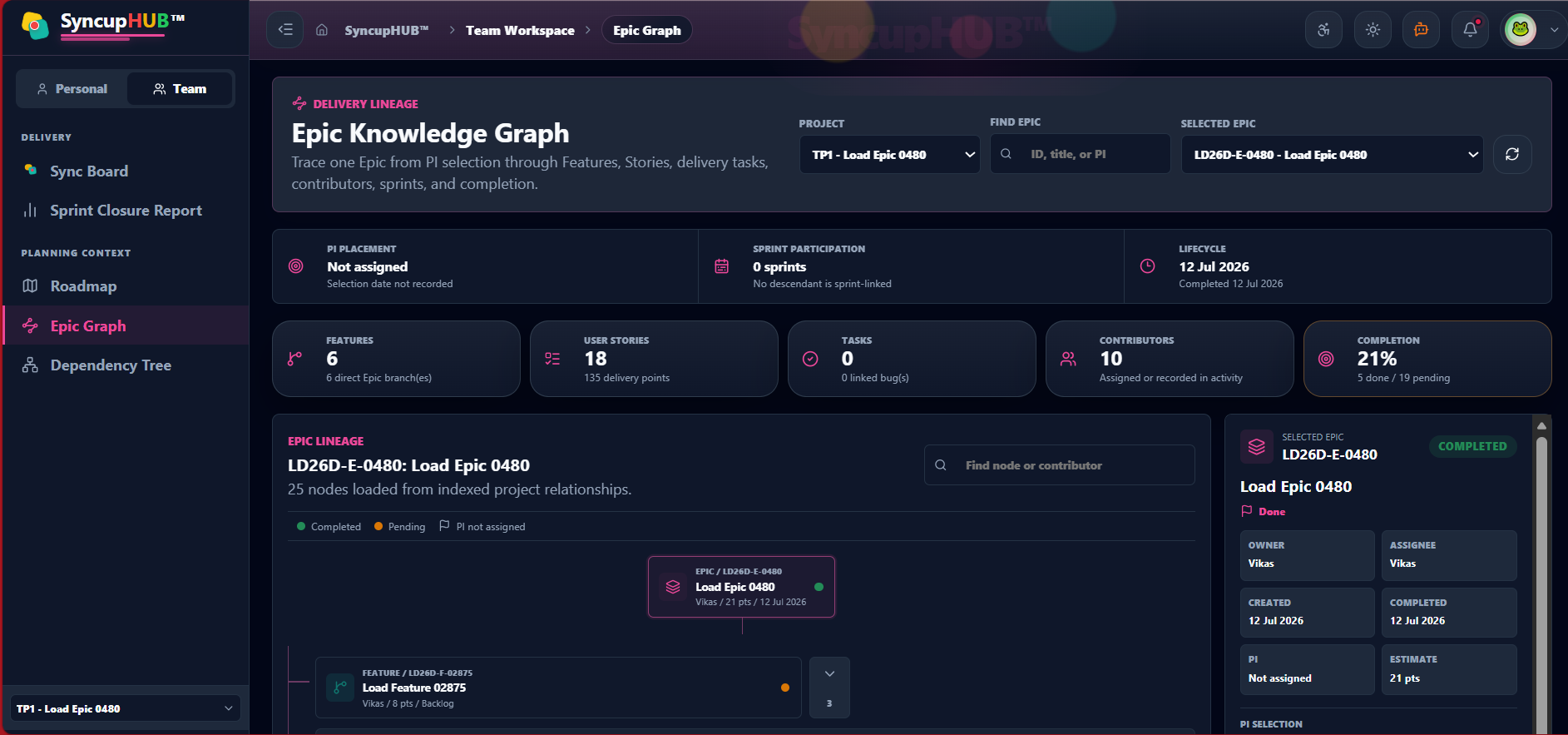
AI documentation and delivery lineage
The full catalogue
Everything in the workspace, and what each part needs.
Sixteen capability areas across five stages of the same lifecycle. Where something depends on an integration, a configured service or a human decision, it is marked — because the difference between a catalogue and a promise is whether the prerequisites are written down.
Define the work
Agree what is being built, and why, before a team commits to it.
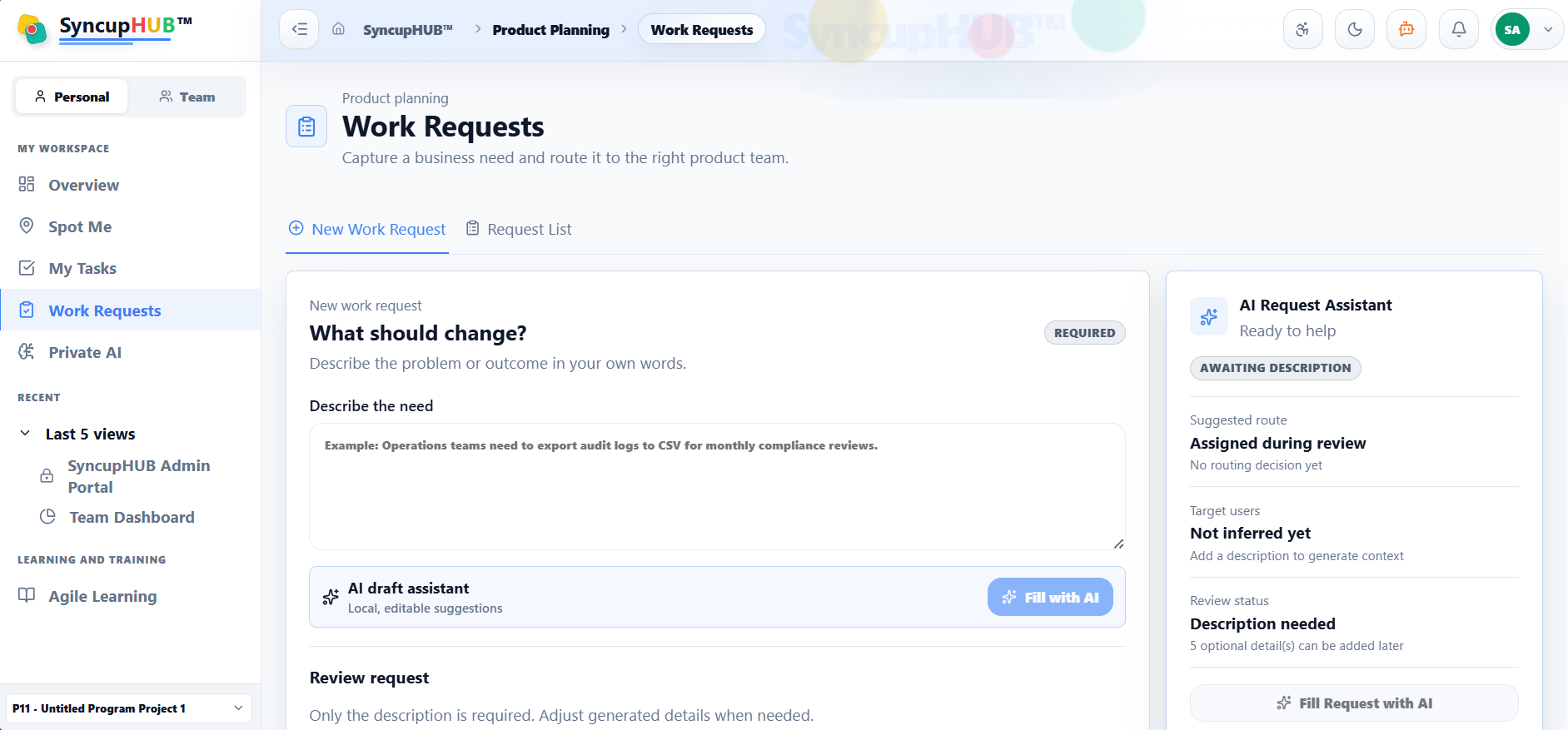
Request intake and approval
Structured intake with business context, triage and ownership, AI-assisted analysis of what is missing, product-fit and backlog-overlap review, then an approval before anything becomes delivery work.
Business Requirements Documents
Larger requests grow into an editable BRD — objectives, scope and exclusions, numbered functional and non-functional requirements, acceptance criteria linked to requirement IDs, journeys, MVP scope, assumptions and open decisions. Versioned, re-approved when the source changes, and exportable to Word.
Confirmed inputs and AI proposals stay labelled separately
Product discovery and customer insight
Customer and account directories, feedback with source references and quotations, and discovery that runs through opportunities, research, hypotheses, experiments and validation — with evidence-linked decision briefs and outcome measurement plans carrying recorded baselines and targets.
Discovery tooling, not a CRM or a product-analytics feed
Deliver it
Keep the requirement attached to the work all the way through execution.
Backlog management and refinement
Epic, feature and story hierarchy in classic or modern views over one shared backlog, with acceptance criteria, dependencies, draft and approval workflows, AI-assisted refinement, and review of duplicate, vague, broad, stale or blocked work — plus recycle and restore.
AI-drafted work stays unestimated until a team estimates it
Estimation and sprint management
Planning Poker, sprint readiness and capacity checks, Scrum and Kanban execution views, work-in-progress limits, impediment tracking, stand-up and retrospective inputs, and sprint closure with configurable quality-readiness checks.
Daily work management
My Tasks and assigned-work views with ownership, status and priority, comments, attachments, watchers and history, saved views, and shareable filter links that keep each recipient’s own permissions.
Steer it
Connect the plan to the people and money behind it, and test a change before making it.
Strategy, roadmaps and programme governance
Objectives and measurable outcomes linked down to real backlog work, programme and project hierarchy, roadmaps and PI planning, cross-project dependencies, budget and investment indicators, roadmap scenarios with stated assumptions, and historical snapshots.
Planning scores are decision support, not delivery probabilities
Resource Twin — capacity and workforce planning
Profiles, pools, skills and proficiency, working calendars and availability, allocations, and adjustments for leave, training and support. Signals for overload, skill gaps, bottlenecks and single-specialist dependency. What-if scenarios move capacity between projects, add leave, remove a critical resource, add contractor or new-hire capacity, or upskill someone.
Approving a scenario does not change live allocations
Delivery Twin — delivery intelligence
A connected model of your delivery operation you can question: source reconciliation and data-quality checks, evidence freshness, forecasts with confidence ranges where the evidence supports them, scope and dependency scenarios, critical-path analysis, planned-versus-actual history, and recorded recommendations and decisions.
Forecast quality depends on how complete your evidence is
Prove it
Make readiness something you can show rather than assert.
Quality Intelligence
Test repositories, cases, sets and plans with review and approval, versioned tests whose approved versions are protected, executions and results, linked defects, requirement-to-test traceability, coverage for committed stories, quality gates with recorded decisions, and sprint quality reports.
Automation import and external evidence storage need configuring
Engineering evidence and releases
Repository and provider connections that link commits, pull requests, builds, tests and deployments back to the work item, code-quality KPIs, release tracking and readiness reviews with recorded approvals, a DevSecOps workspace, CI evidence ingestion, and deployment and rollback planning.
Connects your repository and CI — does not replace them
Reporting and executive visibility
Persona dashboards for team, project, programme and executive views, sprint and closure reports, quality and engineering KPI boards, and a Report Builder with tables, KPIs, bar and line views, saved definitions, filters, scheduled runs and snapshot history.
Supported analytical views show missing data as missing
Share and govern it
Keep knowledge close to the work, and keep the workspace accountable.
AI Documentation and architecture intelligence
Repository-based documentation with source-linked findings, static route, contract and dependency extraction, candidate business journeys a person confirms, architecture diagrams, snapshot and baseline comparison, change-impact analysis, and links from findings to remediation stories and architecture decisions.
Static analysis does not prove runtime behaviour
Spaces and Canvas
Collaborative documents with comments, suggestions, approvals and version history. Visual boards with flowchart, UML, ERD, architecture, cloud and Kubernetes shape libraries, reviewable AI-assisted diagram proposals, nodes linked to stories, risks and decisions, and import from draw.io, Mermaid, Visio and selected Lucidchart exports.
Import fidelity is format-specific
Organisation, security and administration
Organisation, centre, department, programme, project and team structure, role-aware navigation, tenant and project-scoped authorization, enterprise identity with SCIM, credential protection, audit trails, access-review campaigns, retention policies, privacy-request intake, and AI access and provider controls.
Product controls, not a compliance certification
Learning and team engagement
An agile training catalogue with assignment and personal learning views, plus Spot Me — an organisation feed for team updates, shared learning and appreciation.
Integration-dependent features and AI generation depend on what you configure and on the provider policy you set, so they are not switched on for every customer by default. See the controls behind them.
Executive intelligence
Move from live evidence to confident decisions.
Give executives and portfolio leaders a purpose-built command layer over the same work teams update every day. No separate reporting model and no stale status deck.
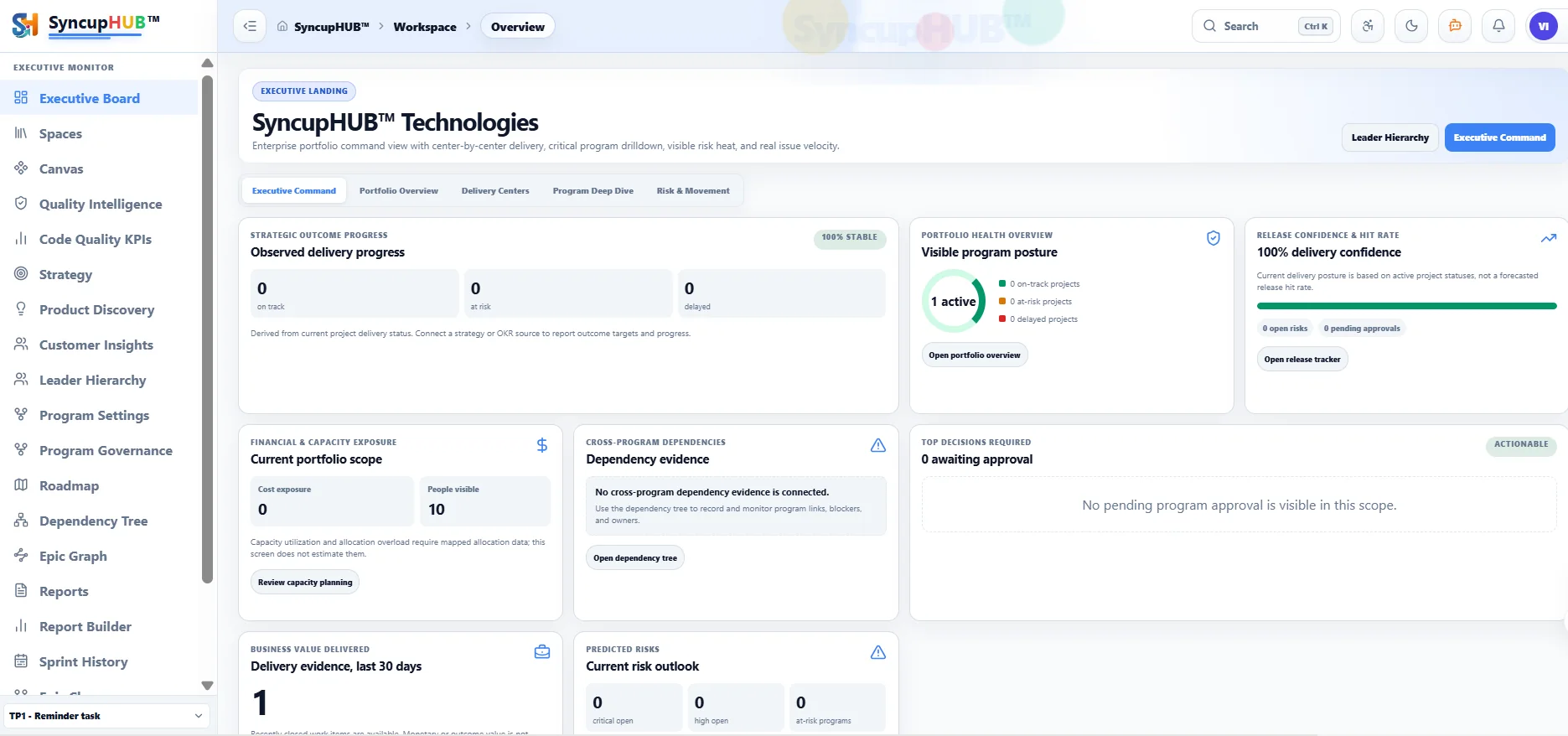
Executive Command
See what needs leadership attention now.
Bring strategic outcome progress, portfolio posture, release confidence, financial exposure, dependencies, approvals, delivered value, and predicted risk into one decision surface.
Live, evidence-backed portfolio signals
Role-specific leadership workflows
Decisions connected to owners and action
Think, map, and document
From a blank canvas to verified technical truth.
SyncupHUB keeps collaborative thinking and technical evidence inside the same value stream, so the reason behind a decision never disappears from the work.
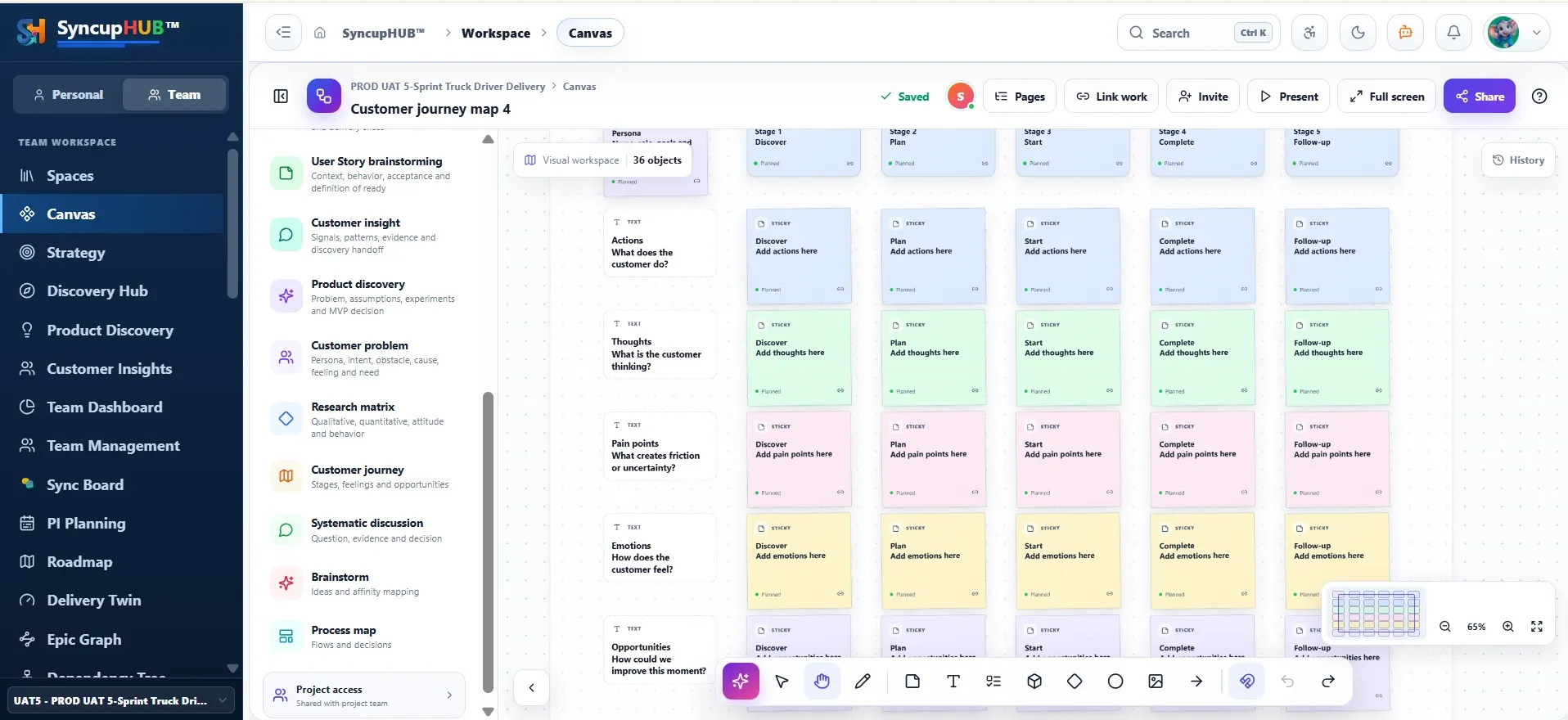
Canvas collaboration
Shape ideas together before they become delivery commitments.
Run discovery, quarterly planning, customer journey mapping, and feature brainstorming on a flexible visual canvas. Reusable templates, sticky notes, linked work, history, and live collaboration keep decisions connected to execution.
Visual planning templatesSticky notes and resizable cardsLinked work and presentation mode
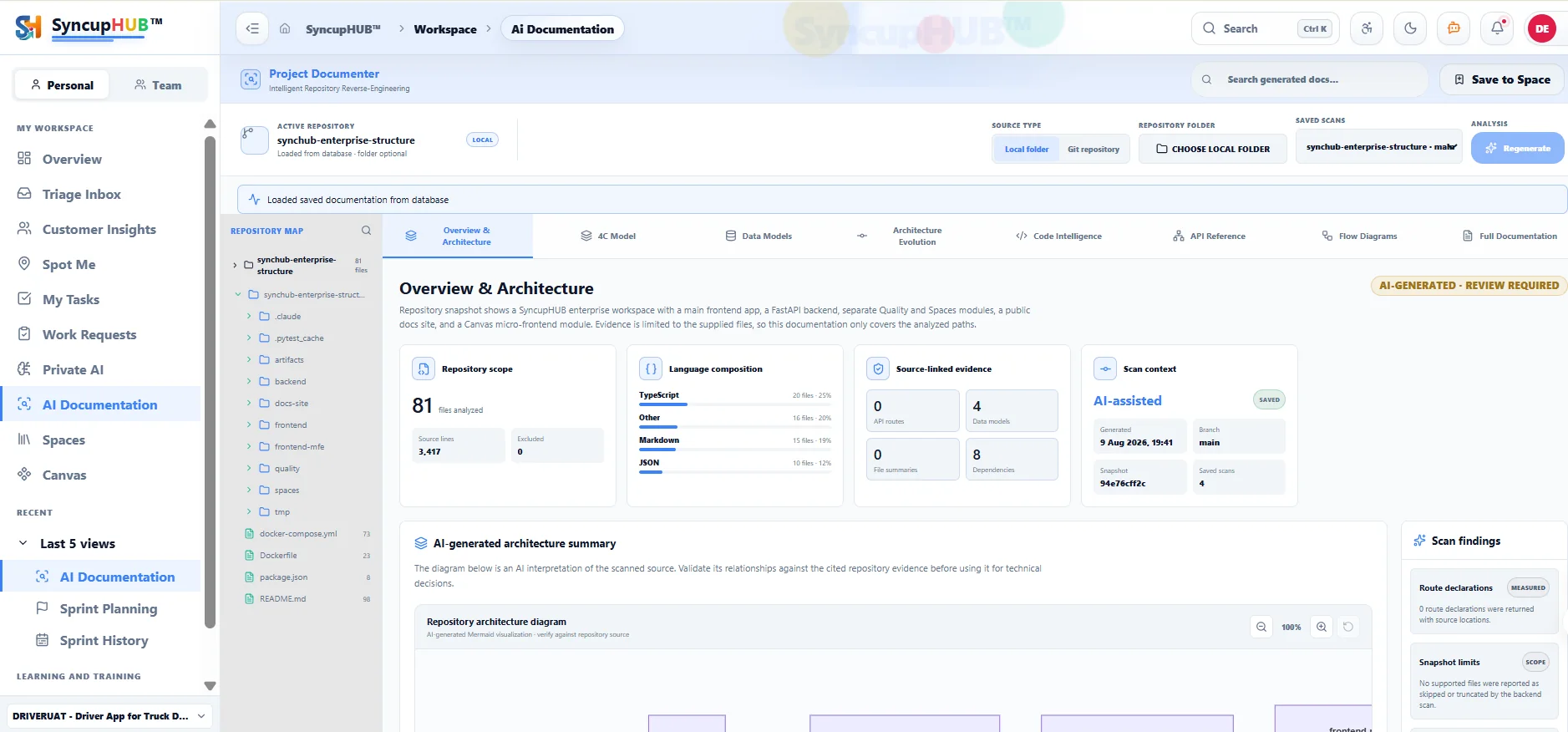
AI Documentation
Turn repository evidence into architecture everyone can understand.
Analyze source code and generate source-linked architecture, API, schema, flow, and code intelligence. Teams can review verified evidence, save documentation to Spaces, and keep technical knowledge close to the work it supports.
Repository-backed evidenceArchitecture and flow diagramsSaved, searchable documentation Spaces
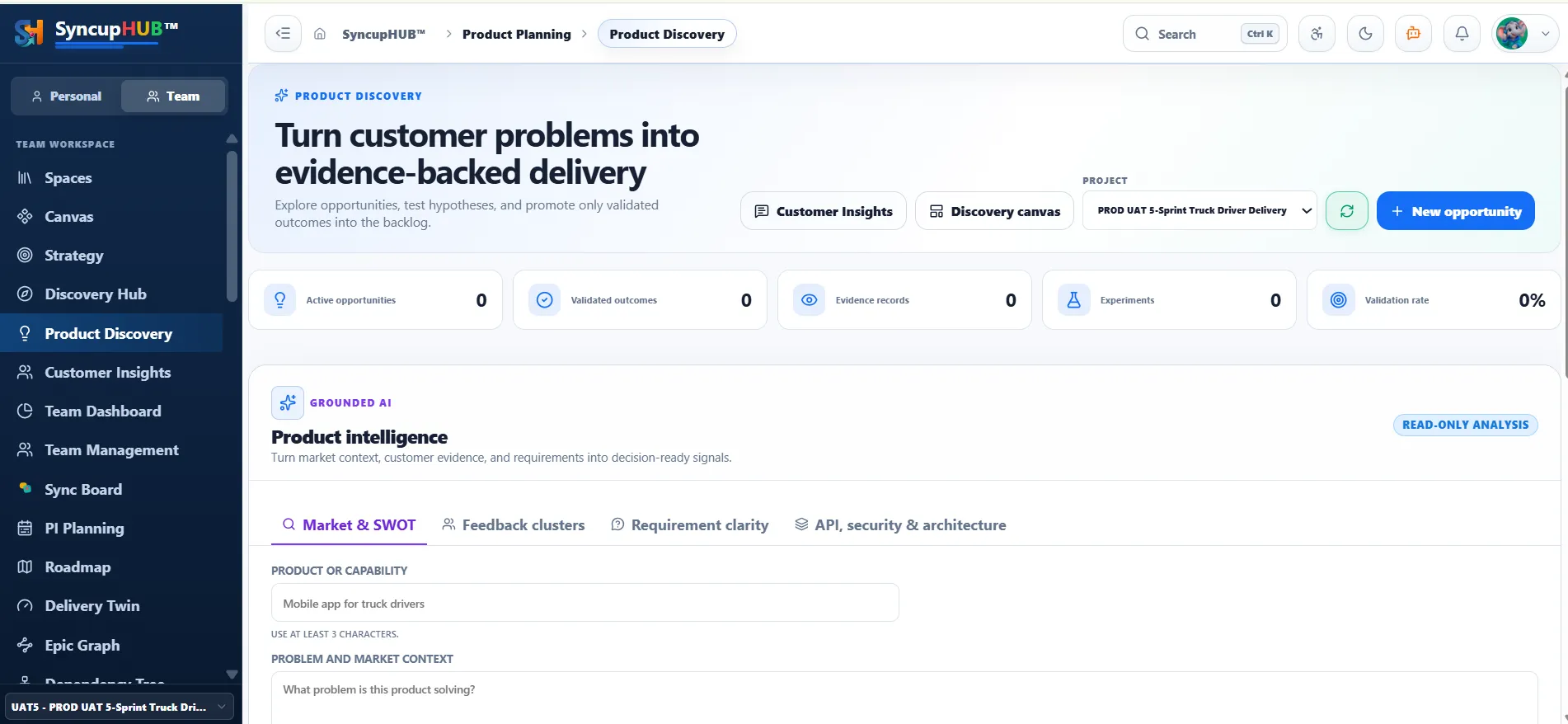
Product discovery
Turn customer problems into evidence-backed delivery.
Explore opportunities, test hypotheses, and promote only validated outcomes into the backlog. Grounded AI turns market context, customer evidence, and requirements into decision-ready signals — so teams build what the evidence supports, not what the loudest voice suggests.
Opportunity and hypothesis trackingMarket, SWOT, and feedback clustersOnly validated work reaches the backlog
Enterprise by design
A secure operating layer leaders can trust.
Unify execution without compromising identity, controls, auditability, reliability, or data privacy. Start with one team and scale across the enterprise.
Relevant for every decision-maker around delivery.
SyncupHUB™ gives executives, operators, and people leaders their own view of the same delivery reality — without fragmenting the data behind it.
Executive perspective
Lead from one delivery cockpit.
Monitor portfolio health, regional execution, delivery risk, integration performance, and leadership depth in one governance view.
See a single operating picture across programs, workstreams, and teams.
Connect delivery activity to business milestones and portfolio risk.
Spot capacity pressure, indirect contribution, and succession gaps earlier.
What this buyer sees
Role-based
Priority view
Execution signals arranged around business outcomes, not isolated team updates.
Decision velocity
Faster escalation handling, milestone review, and cross-team coordination.
Leadership signal
Risk, capability, readiness, and contribution surfaced in one workflow.
Commercial strategy
Three ways to run it. Clear enterprise economics.
SyncupHUB™ can be self-hosted with no licence fee, run in the cloud at one predictable per-user price, or scoped as an enterprise deployment with private AI in your own tenant.
Full platform — execution, governance, people, and executive views
Built-in AI suggestions across backlog and delivery
SSO / SAML and SCIM provisioning
Tenant-scoped access, audit trails, and access-review campaigns
Start with one team, expand across programs and shared services
One connected operating layer
Everything teams need to move from strategy to value.
No feature gates
Strategy and portfolio
Connect priorities, investments, milestones, and measurable outcomes.
Product and delivery
Move from demand intake through planning, execution, and release readiness.
Governance and KPIs
Turn live delivery signals into decision-ready portfolio intelligence.
Workforce intelligence
See capacity, contribution, dependency pressure, and leadership depth.
Private AI
Generate source-backed guidance while keeping enterprise data private.
Enterprise controls
Support identity, access, auditability, security, and scalable operations.
Annual platform investment
25 members at $7.65 per user per month
$2,295.00
Live environment
Access the SyncupHUB™ workspace
Guided walkthrough of the executive delivery cockpit.
A sandbox tenant pre-loaded with sample programs and delivery signals.
Provisioned access with SSO — no shared passwords.
How a demo runs
We start in the executive cockpit, show how execution feeds governance, then move to matrix contribution and capability visibility — mapped to your delivery model.
How SyncupHUB works as an AI project management and agile delivery workspace — and how it replaces a patchwork of delivery, governance, and reporting tools.
What is SyncupHUB?
SyncupHUB is an enterprise AI project management and agile delivery workspace. It unifies strategy, product backlog, sprints, program and portfolio governance, KPIs, workforce visibility, and executive reporting in one secure platform, so PMOs and delivery leaders run everything from a single source of truth.
Can SyncupHUB replace a disconnected project tool stack?
Yes. SyncupHUB brings product planning, delivery execution, governance, risk tracking, workforce intelligence, and executive reporting into one secure operating layer instead of spreading them across disconnected tools.
How does SyncupHUB reduce status-reporting overhead?
Its AI generates leadership-ready status summaries from live delivery data, so teams stop rebuilding decks and spreadsheets. Leaders get current portfolio health, top risks, and recommended next actions automatically.
How does it improve cross-team visibility and catch release risk early?
SyncupHUB maps direct and indirect contribution across matrix teams, flags overloaded teams and capacity pressure, and forecasts release and milestone risk from sprint trends — surfacing problems weeks before they reach the board.
Why does private AI matter for enterprise project management?
SyncupHUB can run its intelligence inside your own tenant, so delivery, people and governance data need not reach an external provider at all. Where you do allow one, it is a provider you name in policy and every access is recorded — so you keep AI decision support without losing control of where the data goes.
Who is SyncupHUB for?
It is built for enterprise PMOs, delivery and program leaders, scrum masters, product owners, and executives who need agile portfolio management, delivery governance, and release-readiness visibility in one workspace.