Follow one request the whole way
Six steps, one connected system — from the moment a need is raised to the moment a leader decides on it. Walk it yourself below, or have us run it on your own delivery.
Book a walkthrough“Status reaches the steering committee three weeks after the decision was needed.”
Read the signal as it forms.
Milestone drift, dependency impact and the recommended action, modelled continuously rather than collected on a Friday.
“Every team is on a different tool and every number is slightly different.”
One hierarchy under all of it.
Portfolio down to story in one structure, so the executive view and the team board cannot disagree.
“AI pilots demo beautifully and never reach production.”
Agents scoped to real jobs.
Seventeen agents shaped to the work that already exists, reading your delivery rather than a benchmark.
“Nobody can say who approved what the AI just did.”
Every proposal carries an approver.
Agents prepare and propose. A person commits, and the commitment is recorded with their name against it.
A board tells you where the work is. A cockpit tells you where it is going, what is about to go wrong, and what to do about it — while there is still time to act.
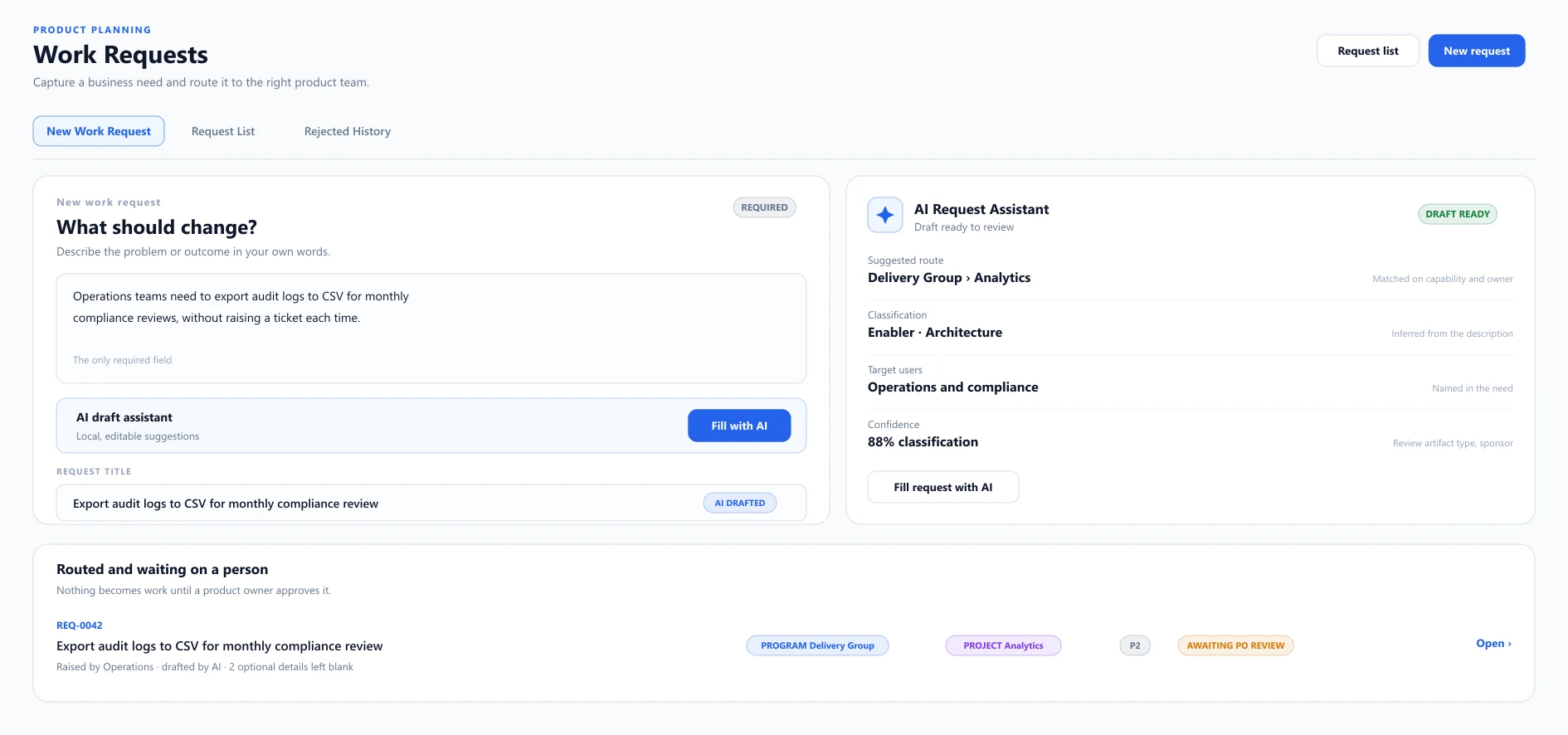
Anyone describes the need in their own words — the description is the only required field. AI drafts the title, the classification, the target users and the route it should take, and shows how confident it is. A product owner then approves it, sends it back for clarification, or routes it to a team.
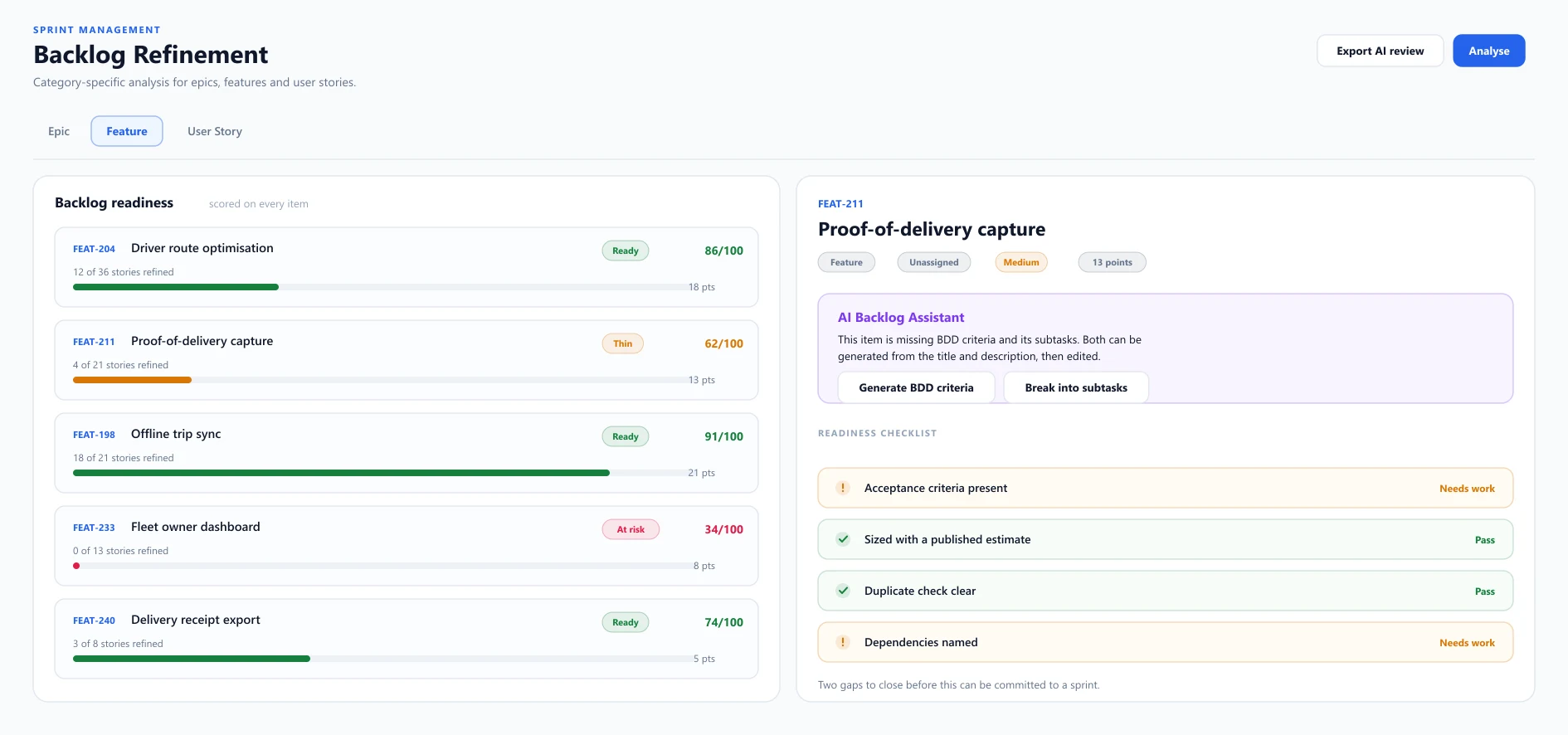
Epics, features, and stories are reviewed for readiness. AI flags what is thin, duplicated, or missing acceptance criteria before anyone commits.
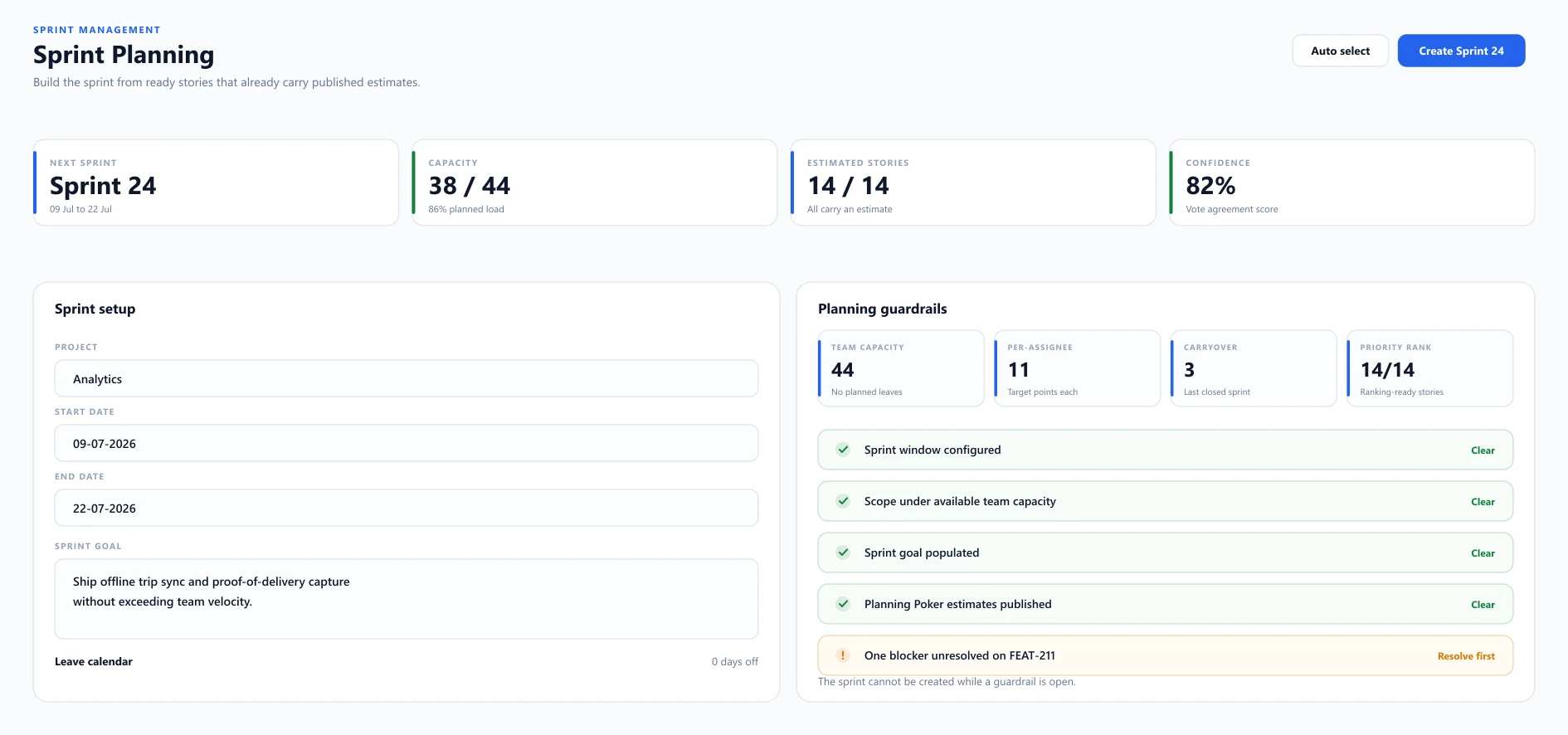
Planning balances priority against real capacity and open blockers, so the sprint your team commits to is one they can actually deliver.
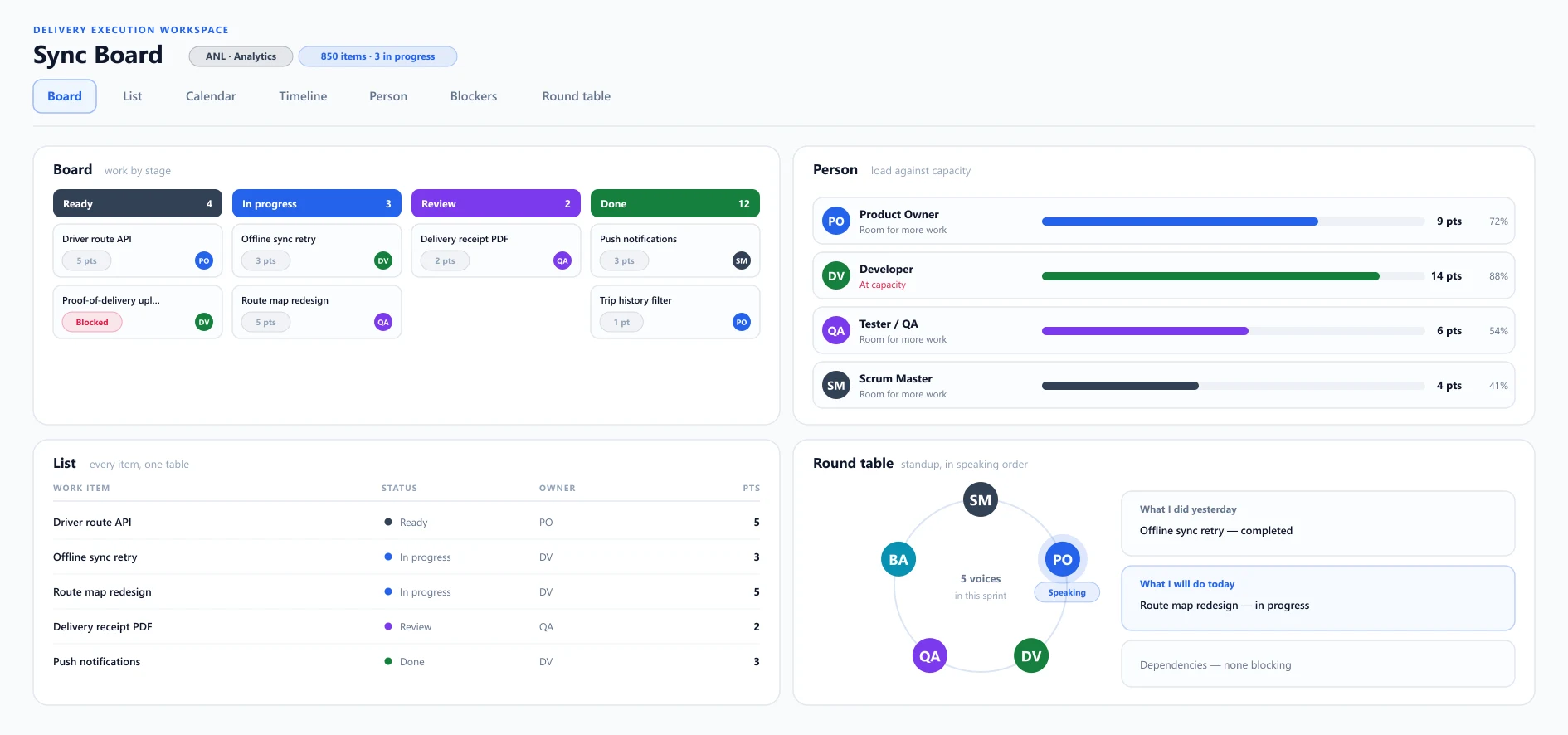
Switch the board and the same sprint answers a different question: stages on the Board, everything at once in List, load against capacity by Person, who is waiting in Blockers, and the daily syncup, a stand-up that runs itself, in Round table.
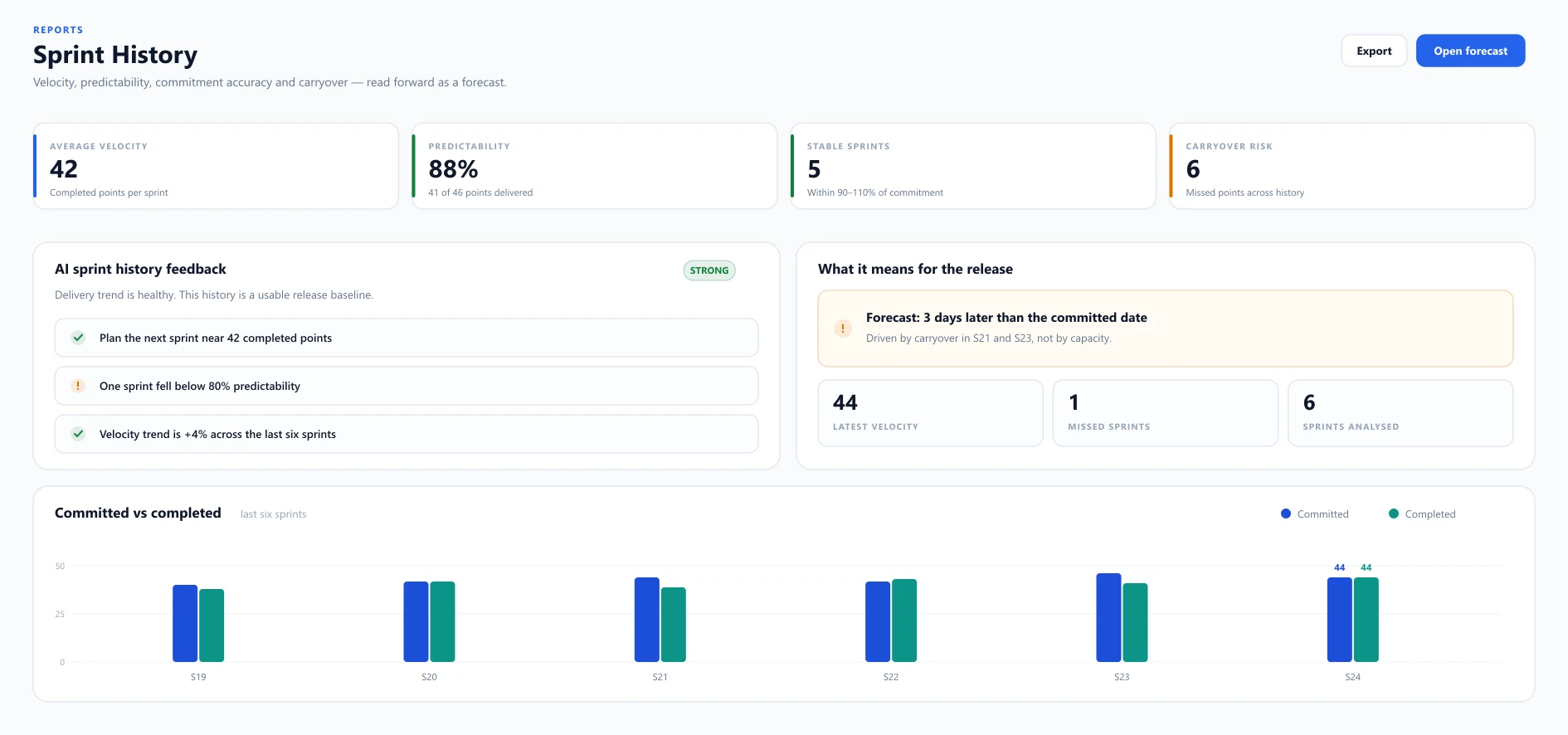
AI reads velocity, predictability, and carryover across sprint history, then tells you what it means for the release — weeks before the deadline.
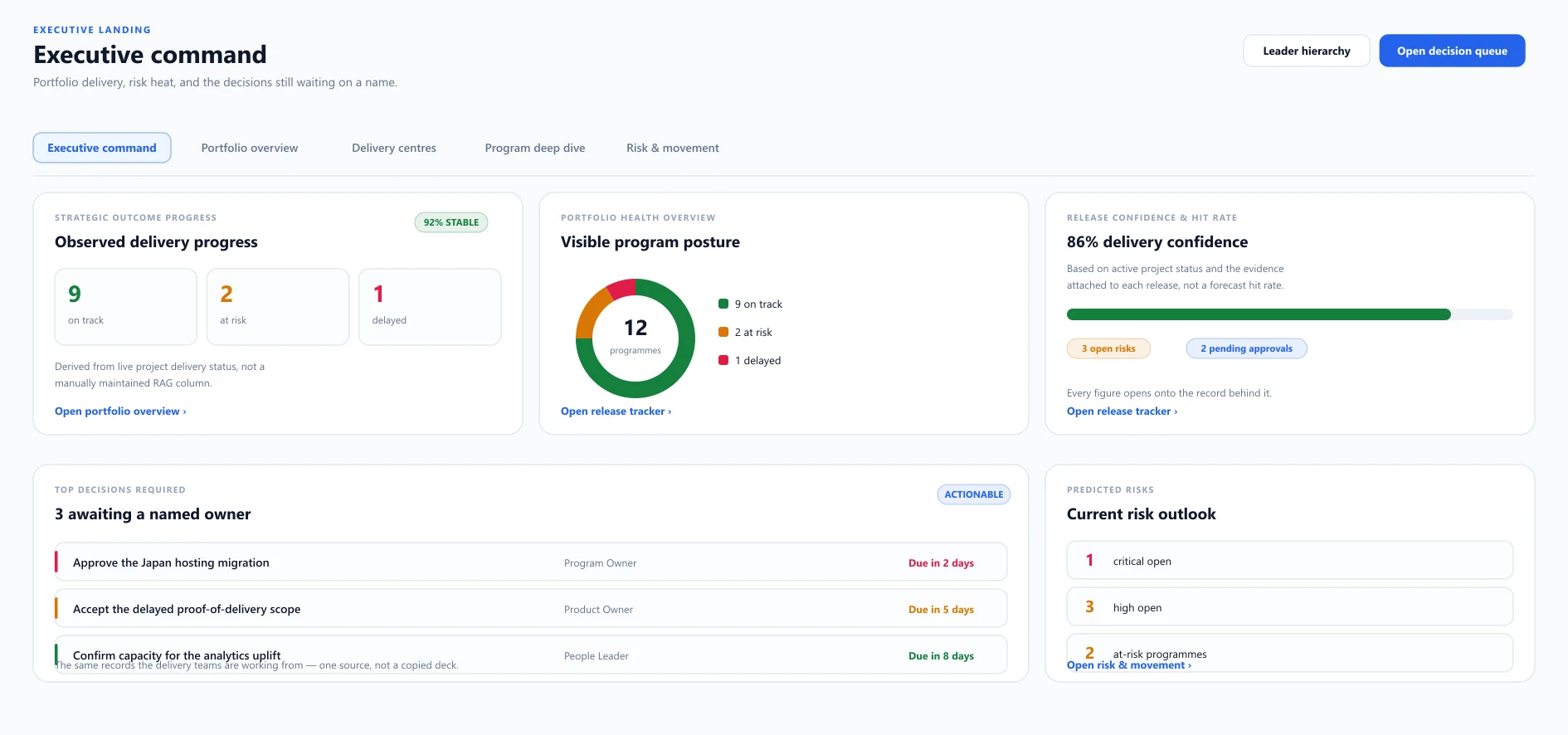
Executives see closure health, ownership, and delivery traceability in one view — the same data the delivery teams are working from.
Nobody books a demo because they want to see a platform. They book one because something specific is going wrong. Tell us which of these is yours and the walkthrough opens there.
“We cannot defend our delivery dates”
Start on the Delivery Twin: forecasts with confidence ranges, critical path, and planned-versus-actual history behind them.
“Our backlog is a graveyard”
Start on intake and refinement: requests clarified before they become work, duplicates and stale items surfaced, BRDs for the big ones.
“We do not know who is overloaded”
Start on the Resource Twin: availability, verified skills, single-specialist dependencies, and what-if scenarios you can test safely.
“Release sign-off is a spreadsheet”
Start on Quality Intelligence: requirement-to-test traceability, coverage on committed stories, and gate decisions that get recorded.
“Nobody understands the legacy system”
Start on AI Documentation: architecture, data models and flows read from the repository, with every claim traced to a file.
“Our AI adoption is ungoverned”
Start on the provider policy and the agent catalogue: what is allowed, who approved it, and what each agent is scoped to do.
What actually happens on the call
No slides. One of us shares a screen, you bring a real situation, and we spend the time on your delivery rather than on a tour of menus.
- 10 minYour scenario, not a sandboxBring one real situation — a programme that slipped, a backlog nobody trusts — and we walk that, not a demo tenant full of tidy data.
- 10 minThe role you actually care aboutThe workspace a product owner, scrum master, QA lead or executive signs into, and the agent working alongside them.
- 7 minWhere it runs and who approvesDeployment options, the AI provider policy, the audit trail — the questions your security review will ask anyway.
- 3 minWhatever you are still unsure aboutPricing, rollout, integrations, what it does not do. We would rather tell you now than in month three.
Not ready to talk? The stepper above is the same walkthrough, at your own pace — and the security page answers what a review will ask, including the things we do not claim.
Book the walkthrough
A real person replies. Usually within a working day.