QA Intelligence
AI-drafted test cases from acceptance criteria, approved by QA and traced to the requirement.
Learn moreRequirement to code. And back.
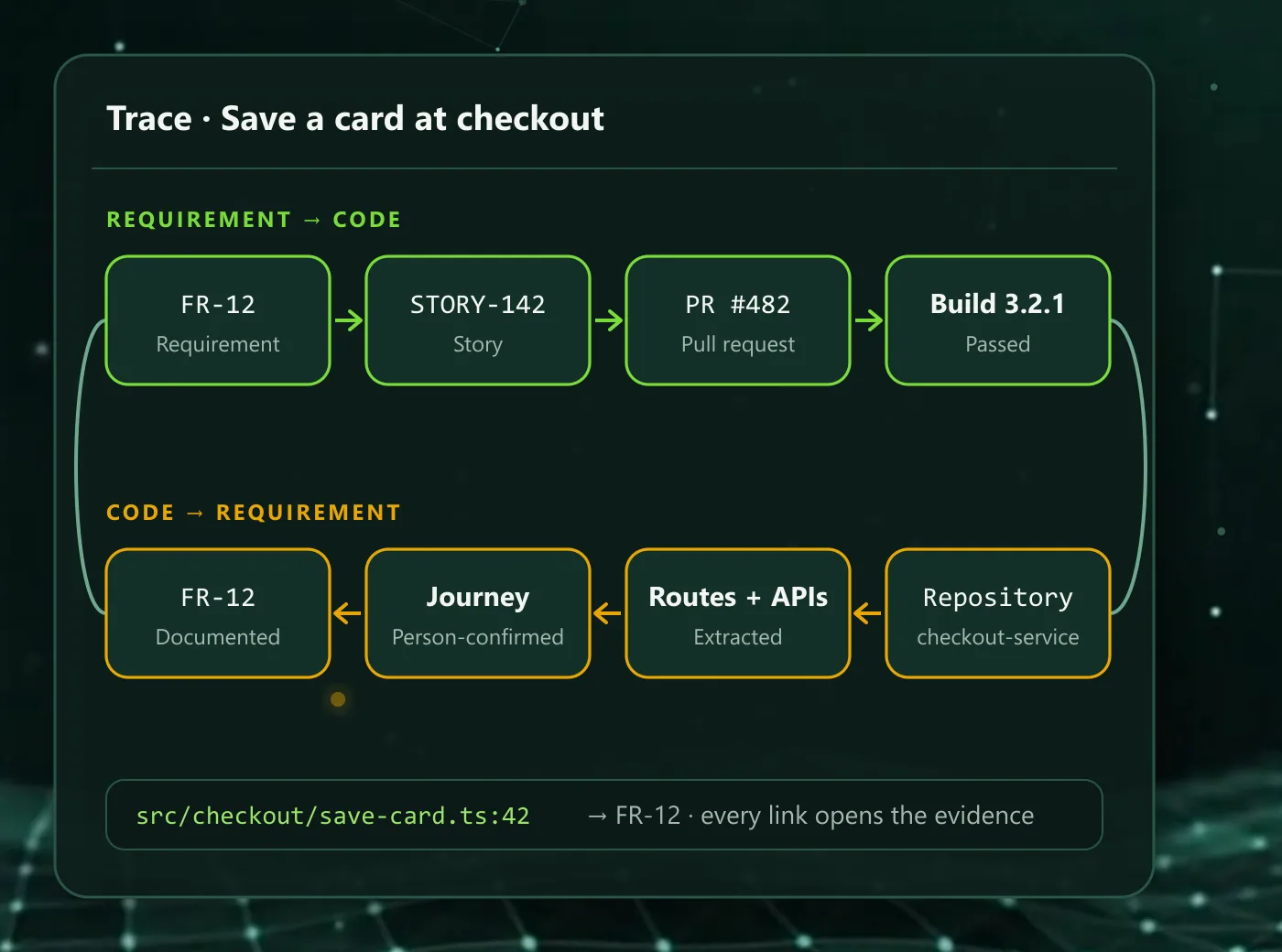
SyncupHUB traces delivery in both directions. Forward, a requirement’s ID travels with its acceptance criteria into stories, then into the commits, pull requests, builds and deployments linked to them. Backward, AI Documentation reads an existing repository and recovers its routes, contracts, architecture and candidate business journeys, which a person confirms and links to requirements.
Requests grow into BRDs with numbered requirements, and each acceptance criterion links to a requirement ID.
Stories keep the requirement they came from, and commits, pull requests, builds and deployments from GitHub, GitLab or Azure DevOps link back to the story.
AI Documentation analyses the repository: static route, contract and dependency extraction, architecture diagrams and candidate business journeys.
A person confirms each recovered journey and links findings to remediation stories and architecture decisions, so documented intent and shipped code meet.
Stated plainly, before a demo does.
It is the ability to follow a requirement to the code that implements it, and back. In SyncupHUB a requirement’s ID travels into its stories, and commits, pull requests, builds and deployments link to those stories, so you can open a requirement and see what shipped for it.
Yes, as a starting point a person confirms. AI Documentation analyses the repository, including routes, contracts, dependencies and architecture, and proposes candidate business journeys. Once confirmed, they link to requirements and stories, which is how teams rebuild lost knowledge of a legacy system.
GitHub, GitLab and Azure DevOps. Commits, pull requests, builds and deployments link back to the work item, and SonarQube code-quality signal can sit alongside the delivery and test evidence for a release.
No. Static analysis describes what the code says, not what it does at runtime, and SyncupHUB labels its findings that way. Every finding links to the source file it came from, so an engineer can check it.
AI-drafted test cases from acceptance criteria, approved by QA and traced to the requirement.
Learn moreDocuments with comments, approvals and version history, kept next to the stories they govern.
Learn moreSeventeen persona agents and 59 sub-agents, all reading the same delivery model.
Learn moreA 30-minute walkthrough on your delivery model, not a generic demo.