The only person who understood it has left
Documentation is a snapshot of what somebody believed. The repository is a record of what was actually done. Reverse engineering turns existing code into architecture, data models, APIs and flows — with every claim traced back to a line.
Short answer
How do you document a legacy codebase nobody understands?
Read it from the code rather than from old documents. A structural analysis of the repository recovers the architecture, data models, APIs and flows that actually exist, with every claim linked to the line it came from, and a person reviews that evidence before anything is published.
Every organisation has at least one system that only one person truly understands. Usually they are also the person most likely to leave.
When they do, the documentation that was supposed to protect you turns out to describe a version of the system that stopped being true three years ago.
Documentation decays. Code does not.
A wiki page is a claim about the system. The code is the system.
The two diverge from the moment the page is written, and nothing in a normal delivery process forces them back together. The diagram is not wrong because somebody was careless — it is wrong because the diagram and the thing it describes are maintained by different people, at different times, for different reasons.
Documentation is a snapshot of what somebody believed. The repository is a record of what was actually done.
Which is why the honest first step in inheriting a system is not “read the docs”. It is “trust nothing you cannot trace to a file”.
Three ways to end up here
The same problem arrives from three directions, and the panic feels identical in all of them:
- Attrition — the engineer who held the model of the system in their head has gone, and the handover was two weeks of meetings and a folder of screenshots
- Inheritance — an acquisition, a supplier change or a reorganisation has left you owning a codebase nobody in the building wrote
- Migration or redesign — the system has to change, and nobody can say with confidence what depends on what
In each case the missing artefact is the same: a current, evidence-linked map of the architecture, the data models, the APIs and the flows between them. Not somebody’s recollection of it, and not a diagram drawn from that recollection.
What a repository can tell you about itself
A codebase is not a mystery. It is an under-read source of fact. A structural analysis of one produces an inventory rather than an opinion:
- Architecture — the components, layers and boundaries that actually exist, rather than the ones on the whiteboard
- Data models — entities, fields and relationships, read from the schema and the code that touches it
- APIs — the routes exposed, what they accept and return, and which of them nothing has called in two years
- Dependencies — internal and external, including the ones nobody remembers adding
- Application flows — the path a request actually takes, end to end, through the layers that are really there
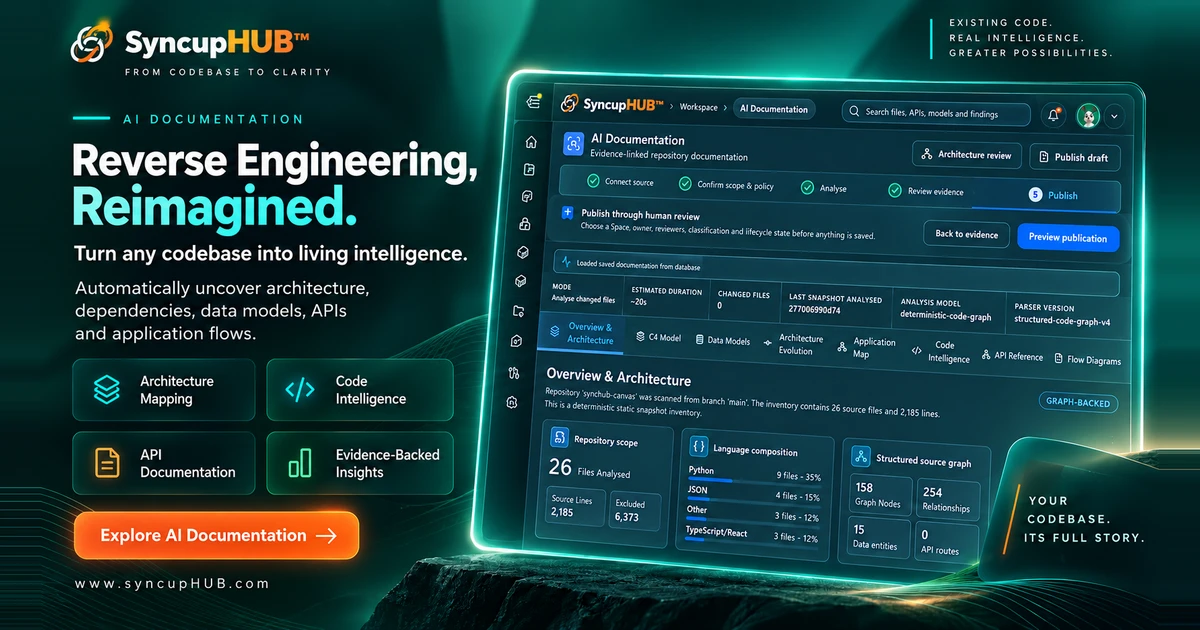
A scan reporting 26 source files, 2,185 source lines, 158 graph nodes and 254 relationships is not a summary. It is an inventory, and every item in it points back at a line you can open.
The unglamorous numbers matter too. Which files were excluded and why. Which branch was scanned. Which parser version produced the graph. A snapshot you cannot reproduce is an anecdote.
Evidence-linked, or it is just a plausible summary
This is the distinction that decides whether generated documentation is useful, and it is where most tooling in this space falls down.
A language model asked to describe a codebase will produce something fluent, structurally reasonable and impossible to verify. It will also be confidently wrong about the parts it inferred rather than read — and nothing in the output tells you which parts those were.
The alternative is a deterministic source graph underneath, with the model used to explain what the graph found rather than to guess at what the code does. Every claim carries a pointer: this component, from these files; this relationship, from this call; this entity, from this schema.
If a statement cannot be traced to source, it should not appear. That single constraint is the difference between documentation you can put in a migration plan and documentation you can only put in an onboarding deck.
Nothing publishes without a human
Generated documentation that publishes itself is simply a new kind of debt — now with the authority of looking official.
The pipeline that avoids that is deliberately unexciting: connect the source, confirm scope and policy, analyse, review the evidence, then publish. And publishing is its own decision — a space, an owner, named reviewers, a classification and a lifecycle state, all chosen before anything is saved.
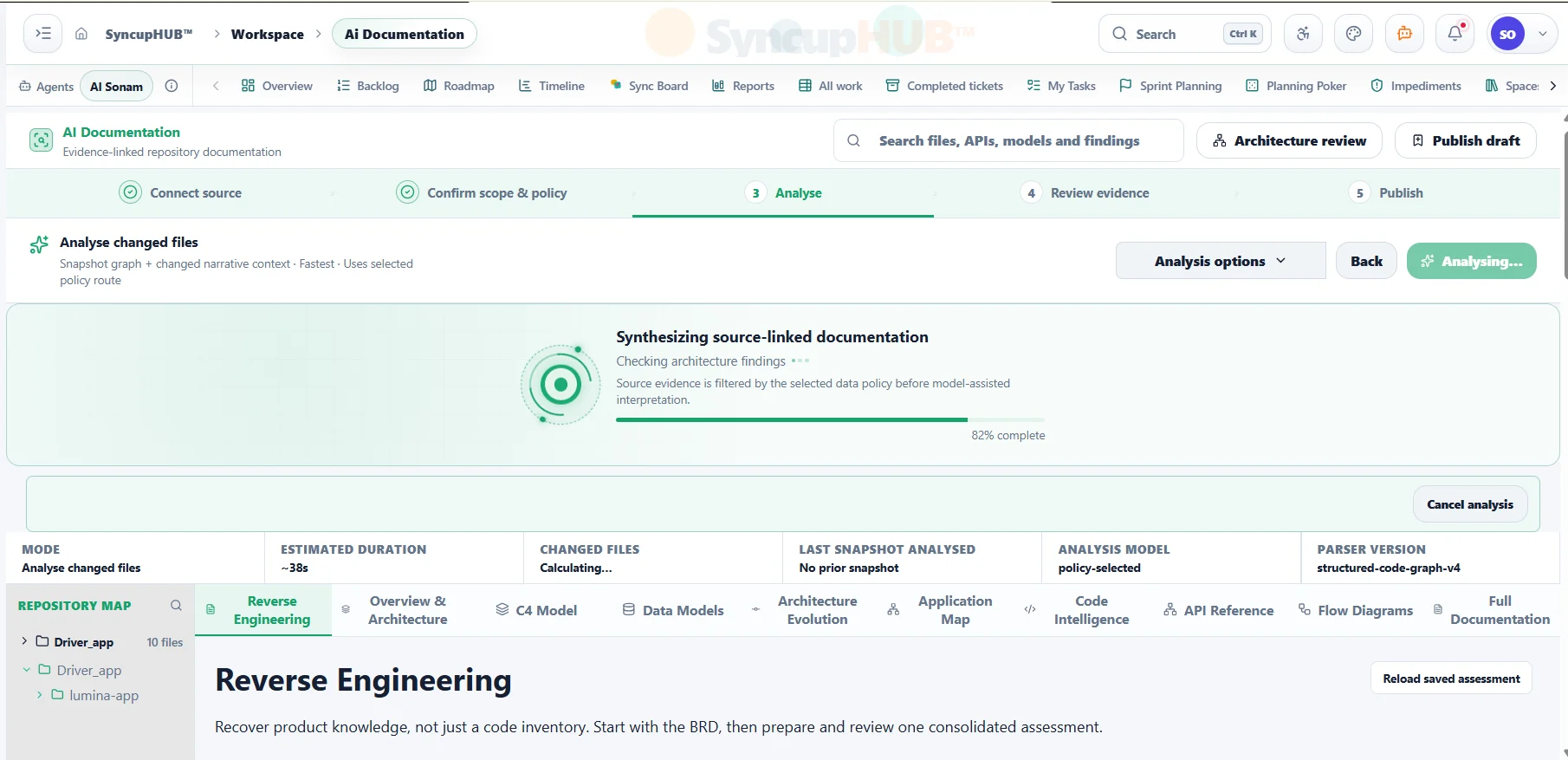
The review step is not ceremony. It is where somebody who knows the business decides that a technically accurate description is also a true one. The graph can tell you a service exists and what calls it. Only a person can tell you it was deprecated last quarter and the replacement is half-built.
What changes on the three bad days
On the day someone leaves, the handover stops being a calendar problem. The structural knowledge is already extracted and reviewed; what the departing engineer owes you is the reasoning, the history and the warnings — the things a graph genuinely cannot hold.
On the day a migration is scoped, the plan is built on a dependency graph rather than a workshop. The estimate changes, because the surprises that normally arrive in month three arrive in week one, when they are still cheap.
And on the day a redesign is proposed, the argument moves from opinion to evidence. Everybody in the room is looking at the same map, and the map can be checked.
A codebase nobody understands is not an asset. It is a liability with a login.
A codebase that explains itself, with every claim traced to a line, is institutional memory.
Features in this article
SyncupHUB runs this inside your own tenant — a delivery model that reads the signal as it forms, with an agent for every role.
Keep reading
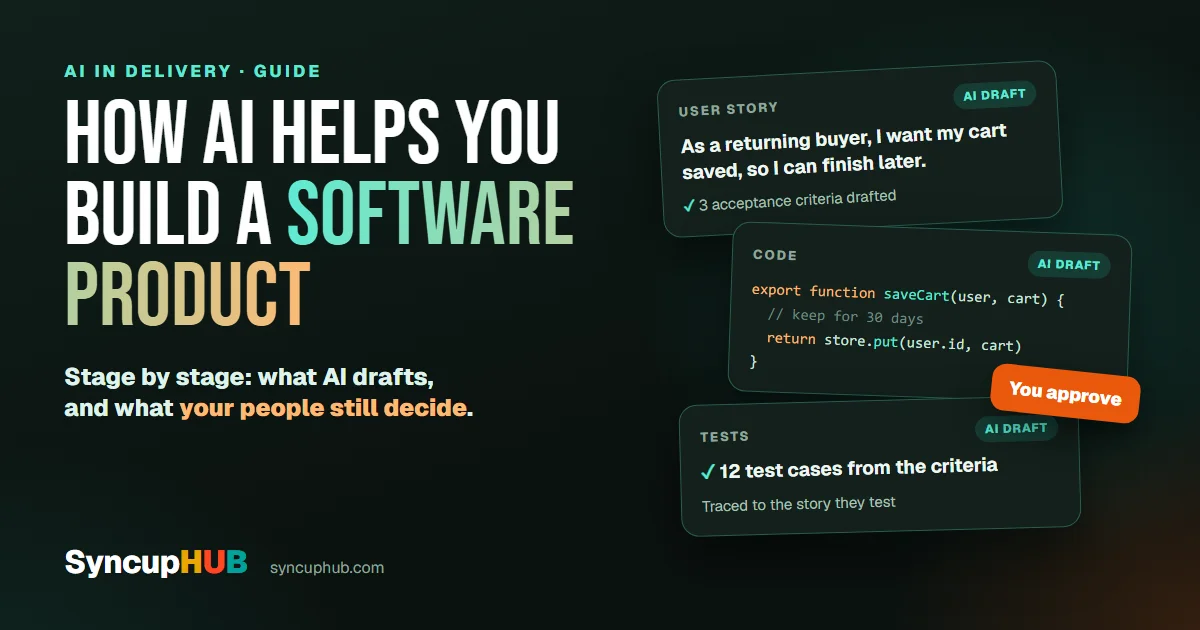
How AI helps you build a software product, stage by stage
Where AI genuinely helps in software product development, from discovery and requirements to code, tests and release, and what your people should still own.
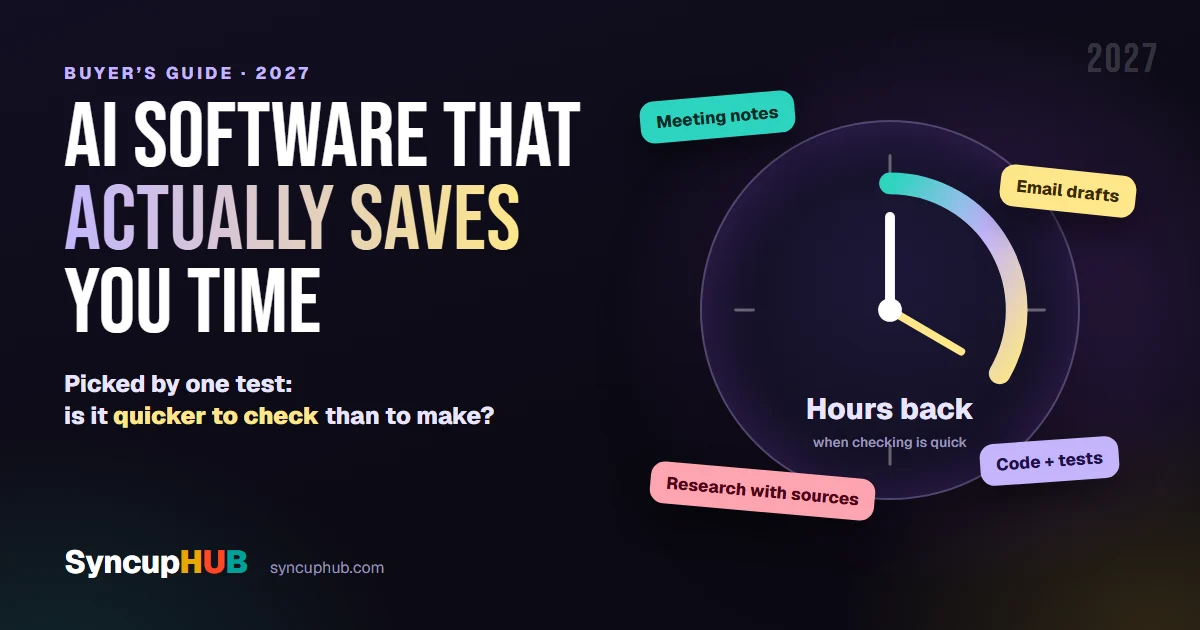
AI software that actually saves you time in 2027
The AI tools that genuinely save hours, from meeting notes to code, task by task, and a simple test for spotting the ones that only add work.