What a delivery digital twin actually models
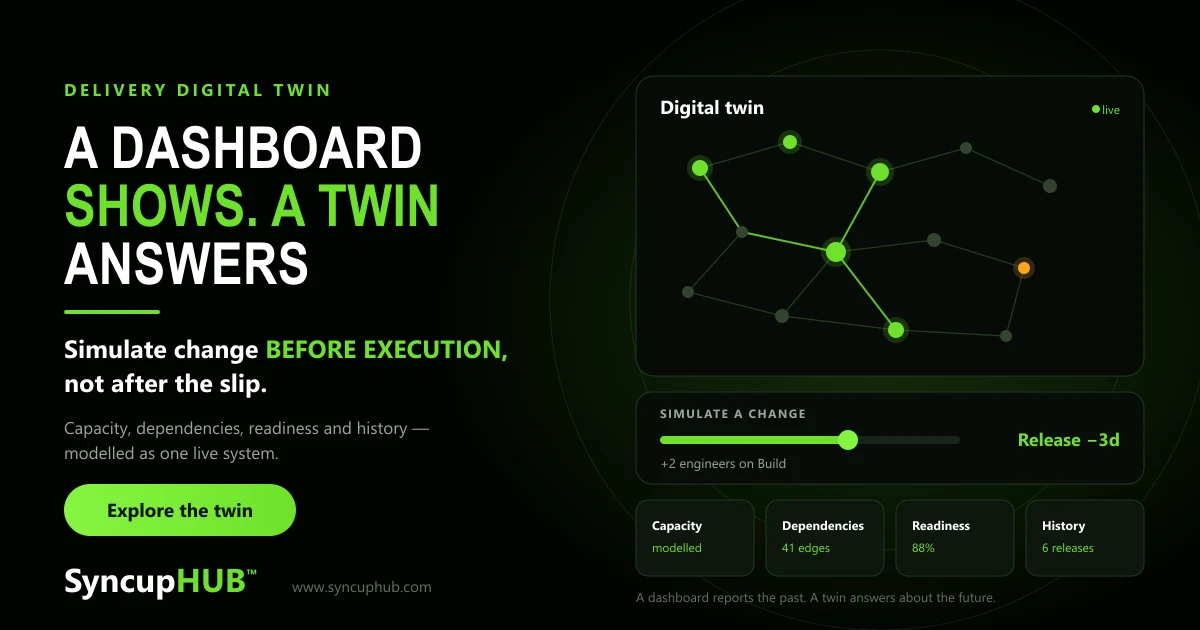
The term arrived from manufacturing and got attached to dashboards. A twin is not a view of your delivery. It is a model you can ask questions of before you commit.
Short answer
What is a delivery digital twin?
A delivery digital twin is a model of your delivery that you can ask questions of before you commit. Where a dashboard shows the current state, a twin holds how capacity, dependencies, readiness and history interact, so you can change one and see what happens to the others.
A dashboard shows state, a twin answers questions
A dashboard renders what is true right now: burndown, capacity, blocked items. It is a mirror. Useful, and entirely descriptive.
A twin holds the relationships between those things — how capacity, dependencies, readiness and historical throughput interact — well enough that you can change one and see what happens to the others. The difference between the two is whether you can ask a question the builder did not anticipate.
What has to be modelled for that to work
Four things, at minimum. Capacity as it actually behaves, including the unplanned work that reliably consumes it. Dependencies as a graph rather than a list, because the second-order effects are where dates die. Readiness, so the model knows the difference between committed work and work that merely has a ticket. And history, so the forecast is calibrated against what this organisation delivers rather than a benchmark.
Miss any one and the model produces confident nonsense. Capacity without history over-promises. Dependencies without readiness under-estimates rework.
The questions worth asking it
If we move two engineers to the payments epic, what happens to the release date, and what breaks downstream. If this vendor dependency slips a fortnight, which commitments are exposed. If we trim scope here, does the constraint move to QA. Which of the risks currently open have actually changed in the last sprint.
These are the questions asked in every planning meeting already. They are usually answered by whoever has the strongest intuition in the room. A twin does not remove that judgment; it gives it something to argue with.
Where it should run
Delivery, people and governance data is among the most sensitive an organisation holds — it describes what is late, who is overloaded and where the money went. A model over that data should run inside the tenant, without third-party model calls, or the security review will end the conversation before the value is ever tested.
Features in this article
SyncupHUB runs this inside your own tenant — a delivery model that reads the signal as it forms, with an agent for every role.
Keep reading
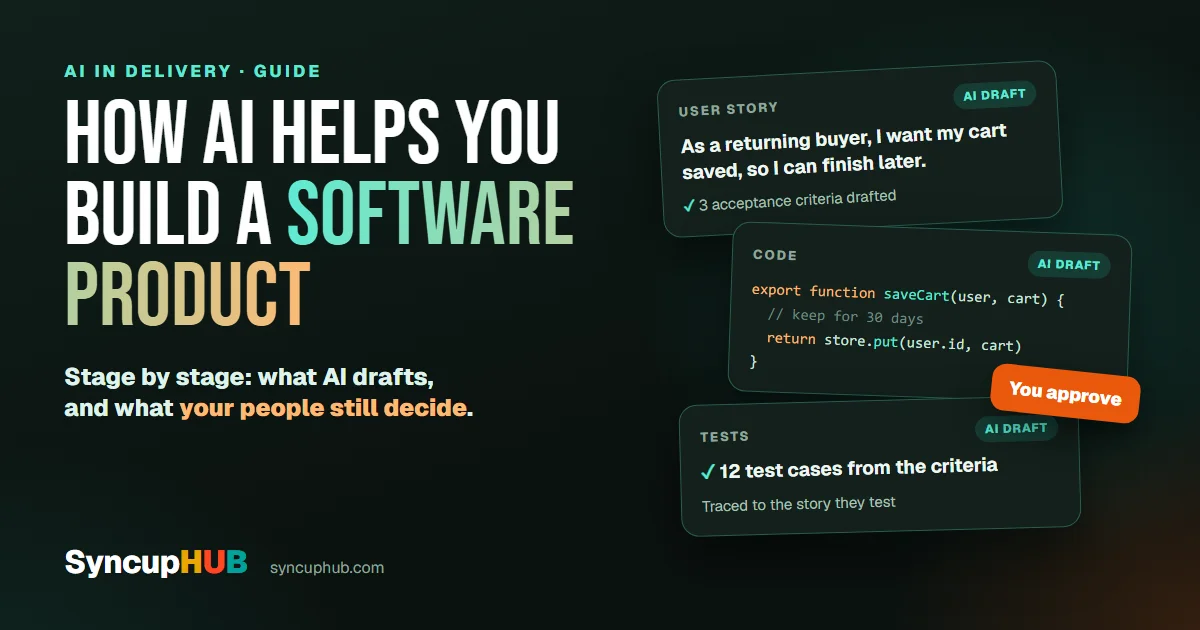
How AI helps you build a software product, stage by stage
Where AI genuinely helps in software product development, from discovery and requirements to code, tests and release, and what your people should still own.
AI software that actually saves you time in 2027
The AI tools that genuinely save hours, from meeting notes to code, task by task, and a simple test for spotting the ones that only add work.