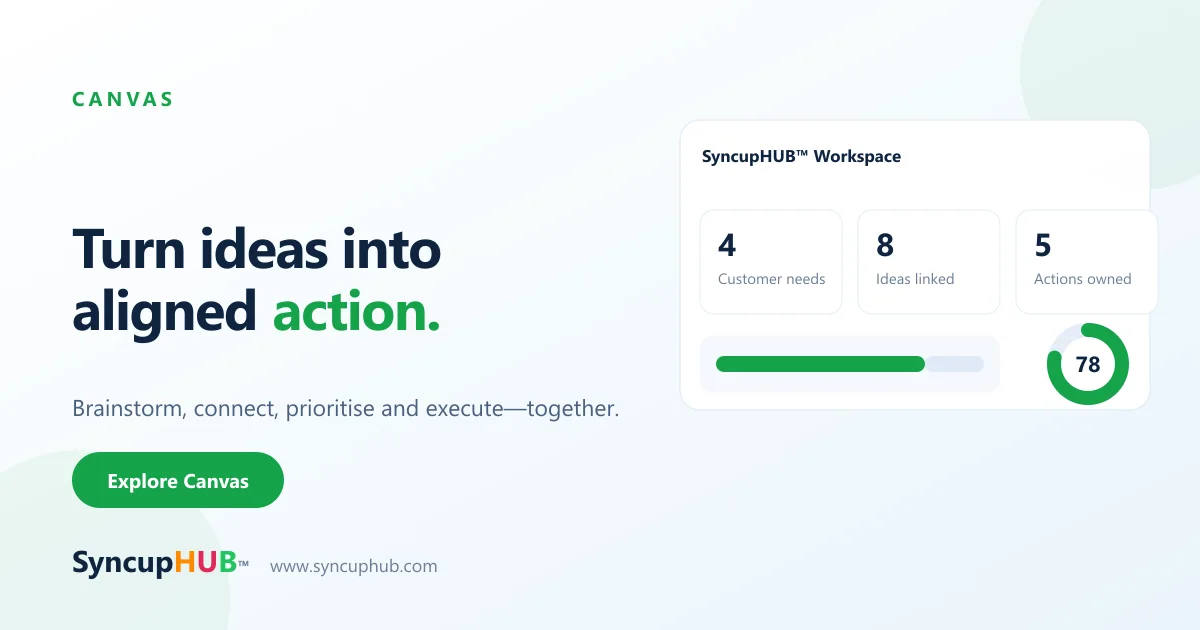
Turn ideas into aligned action
Most workshops end with a wall of sticky notes and no owner. Canvas keeps the thinking attached to the work, and maps dependencies while you brainstorm so blockers surface before they occur.
Short answer
How do you turn workshop ideas into delivery work?
Keep the thinking attached to the work. When discovery runs on the same platform as delivery, a sticky note is linked work rather than a photograph: customer needs connect to ideas, ideas to priorities, and priorities to actions with owners, while dependencies are mapped as the workshop runs.
Every organisation knows how to run a workshop. Far fewer can say what happened to the ideas afterwards.
The gap is not creativity. It is the handover — the moment good thinking leaves the room and has to survive as tickets, owners and dates in a different tool.
Where the thinking usually gets lost
The pattern is familiar. A team brainstorms on a whiteboard, clusters the output, agrees the priorities, and photographs the result. Someone transcribes a subset into the backlog a week later.
What survives that transfer is the conclusion. What is lost is everything that made it a good conclusion:
- The customer need that motivated the idea
- The alternatives considered and set aside
- Why one option ranked above another
- The dependency someone raised in passing
Six weeks later the delivery team asks why a story exists, and nobody can answer without finding whoever was standing at the whiteboard.
Keeping discovery attached to delivery
Canvas runs discovery on the same platform that runs delivery, so a sticky note is not a photograph — it is linked work.
Customer needs connect to the ideas they motivated. Ideas carry the priorities that ranked them. Priorities resolve into actions with owners, and those actions are the same records the delivery teams execute against.
The reason a piece of work exists stays reachable from the work itself, which is the difference between a decision that is documented and a decision that is merely remembered.
Real-time risk telemetry
The more valuable behaviour happens while the workshop is still running.
As ideas connect on the canvas, dependencies form. Two initiatives quietly need the same team in the same fortnight. A high-priority idea rests on an integration nobody owns. A sequence assumes an approval that historically takes three weeks.
Canvas maps dependencies as you brainstorm, flagging blockers before they ever occur.
Surfacing that during planning costs a conversation. Surfacing it in sprint four costs a date. This is the same signal the delivery twin reads later — it simply starts reading it earlier, when the plan is still cheap to change.
From canvas to action plan
A workshop should end with something executable rather than something photographed. The output is an action plan with scope defined, an MVP shaped, a pilot team named and a measure of impact agreed.
Every one of those items is linked back through the priority that justified it to the customer need that started it. When a leader asks why this is being built, the answer is one click away instead of one archaeology exercise away.
A workshop that ends in a photograph is alignment theatre.
One that ends in linked, owned, dependency-checked work is aligned action.
Features in this article
SyncupHUB runs this inside your own tenant — a delivery model that reads the signal as it forms, with an agent for every role.
Keep reading
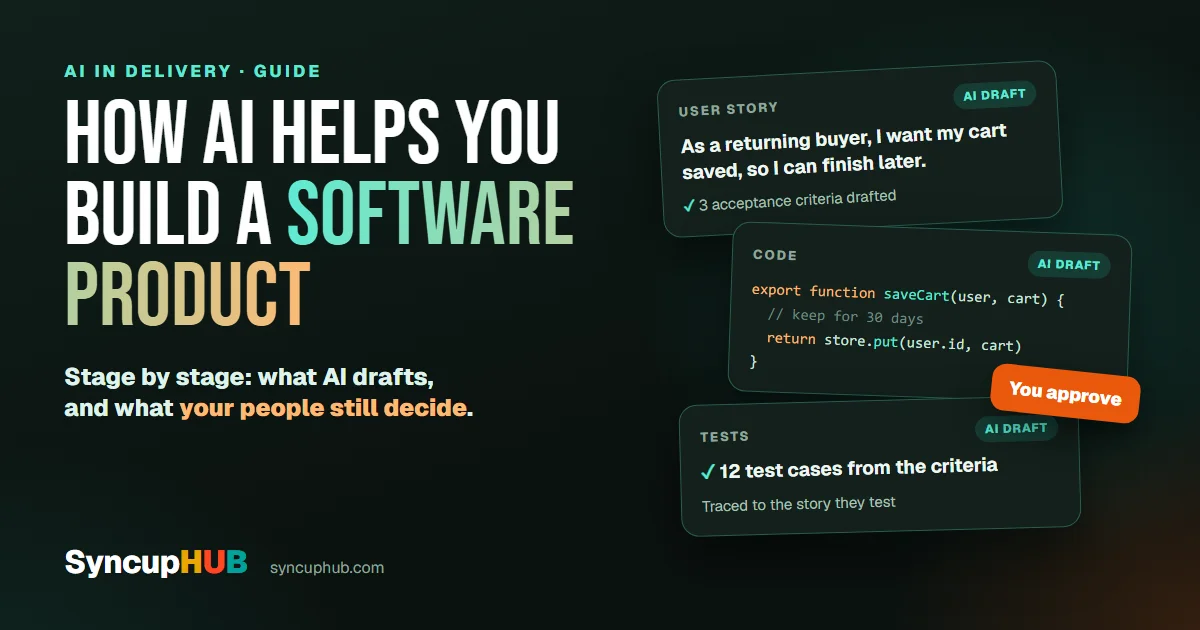
How AI helps you build a software product, stage by stage
Where AI genuinely helps in software product development, from discovery and requirements to code, tests and release, and what your people should still own.
AI software that actually saves you time in 2027
The AI tools that genuinely save hours, from meeting notes to code, task by task, and a simple test for spotting the ones that only add work.