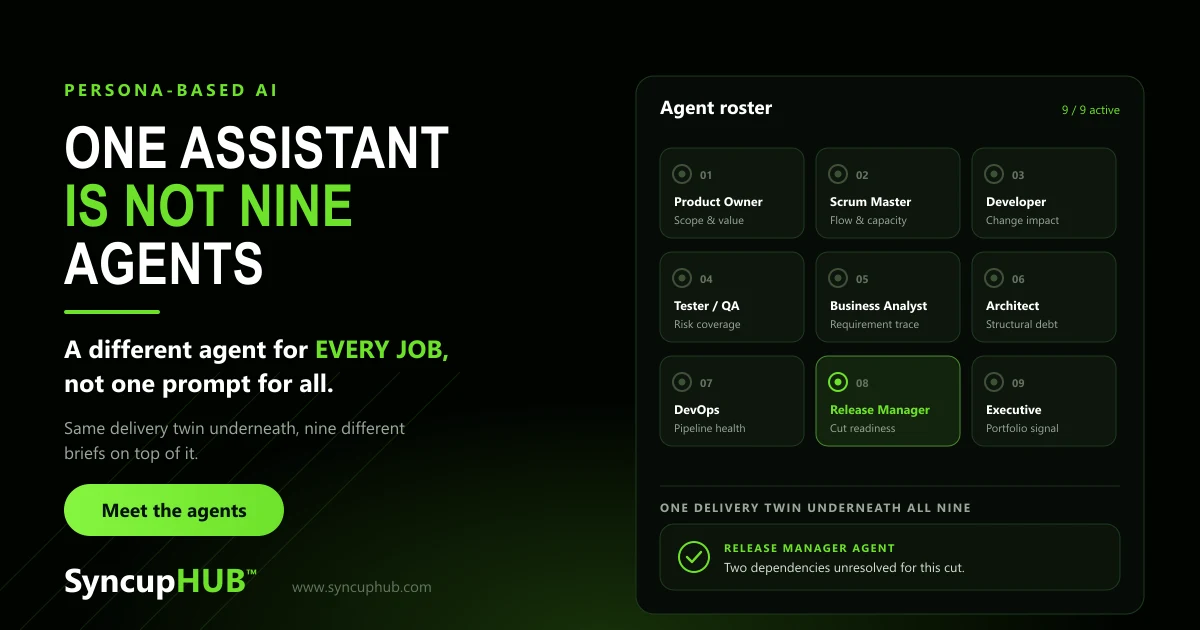
One assistant is not nine agents
Most delivery tools added a single chatbot and pointed it at the whole product. That helps nobody in particular, because a developer, a scrum master and an executive are not asking the same question.
Short answer
Why is one AI assistant not enough for a delivery team?
Because a developer, a scrum master and an executive are not asking the same question. One assistant pointed at a whole product has to guess what each person needs. Agents shaped to a role produce different artefacts, such as a readiness score, a release forecast or a decision queue, not one answer reworded.
The shape most vendors chose
The common pattern across delivery tooling is one assistant, available everywhere, answering whatever it is asked. It summarises a ticket, drafts a description, explains a board. It is genuinely useful and it is the same for everyone who opens it.
That sameness is the limitation. A generic assistant has to guess what the person in front of it is trying to do, and it guesses from a prompt rather than from a role, a queue and a set of decisions that person owns.
Nine people, nine different questions
A developer opening a ticket wants the context that did not make it into the description: why this exists, what the acceptance criteria really mean, which decision upstream constrains the approach. A scrum master planning a sprint wants to know whether the commitment exceeds proven velocity and what to trim. A quality lead before a release wants coverage gaps and flaky specs, not a summary.
An executive wants none of that. They want closure health, financial exposure, and the two decisions that actually need them this week. Answering all of those well is not one assistant being clever. It is different agents doing different jobs against the same underlying delivery truth.
Why the distinction is not marketing
The test is simple and a buyer should apply it in the demo: ask two roles the same question and see whether the outputs differ in kind, not just in wording. A readiness score is a different artifact from a release forecast, which is different again from a decision queue with owners attached.
If nine labels produce nine variations of the same paragraph, that is one assistant wearing costumes. The claim only means something when each agent produces something the others do not.
The economics matter as much as the shape
Per-query pricing quietly caps how much a team uses AI, which caps how much it can matter. If every question costs, people ration questions, and the compounding effect never arrives. Intelligence that runs unmetered inside a tenant gets used by default rather than deliberately, and that difference shows up in adoption more than any feature does.
Features in this article
SyncupHUB runs this inside your own tenant — a delivery model that reads the signal as it forms, with an agent for every role.
Keep reading
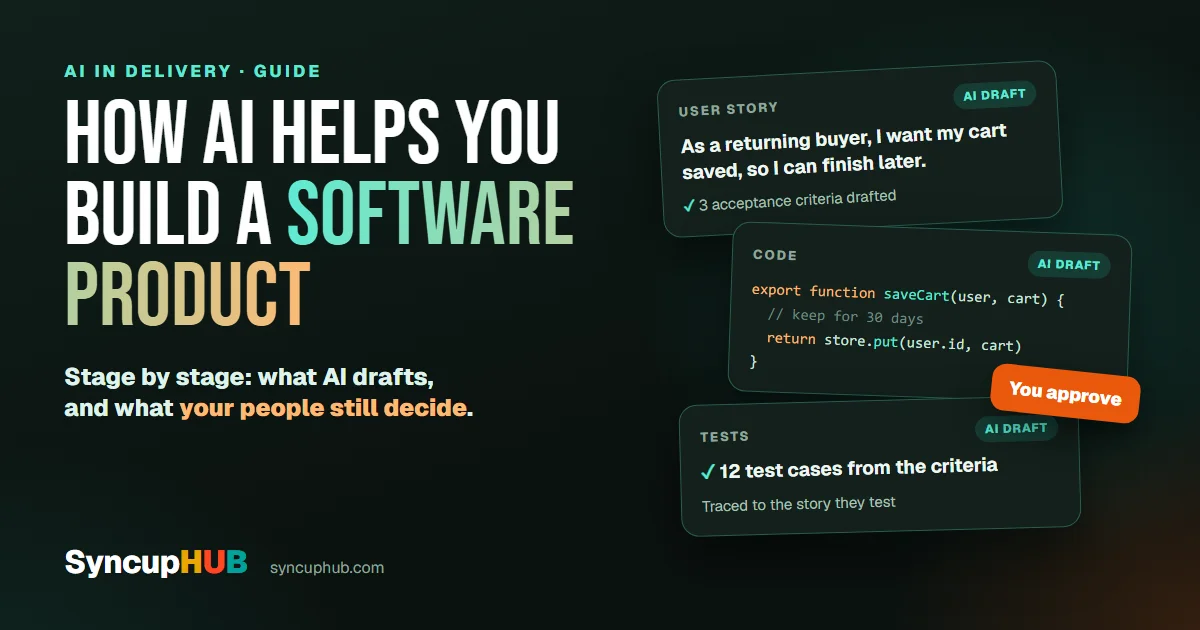
How AI helps you build a software product, stage by stage
Where AI genuinely helps in software product development, from discovery and requirements to code, tests and release, and what your people should still own.
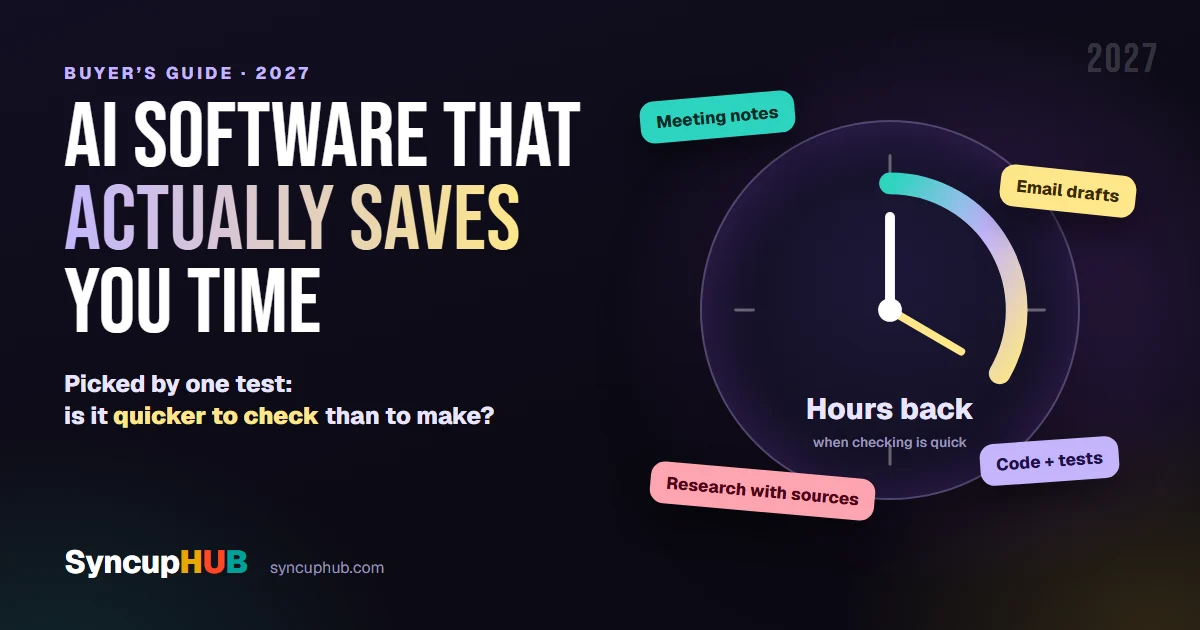
AI software that actually saves you time in 2027
The AI tools that genuinely save hours, from meeting notes to code, task by task, and a simple test for spotting the ones that only add work.