10 Best AI Project Management Tools for Enterprise Delivery in 2026
Compare the 10 best AI project management tools for enterprise delivery in 2026, including SyncupHUB, Jira, Asana, ClickUp, Wrike and Smartsheet.
Disclosure. Published by SyncupHUB, which is one of the ten platforms in this guide. The order and the fit ratings are our editorial judgement, not independent test results or vendor scores. What we say about other products links to their own pages; features and plans change, so confirm them with each vendor.
Short answer
What makes an AI project management tool enterprise-ready?
An enterprise-ready AI project management tool goes beyond task tracking. Evaluate six things: AI-assisted planning, intelligent execution, resource intelligence, business visibility, AI governance and predictive intelligence. The strongest platforms connect work with resources, strategy, business outcomes and decisions, rather than simply adding an AI assistant to a task list.
Project management is changing.
For years, project-management software primarily helped organizations answer questions such as: What needs to be done? Who owns it? When is it due? What is delayed? What is the project status?
In 2026, enterprise organizations need much more. AI is moving project management from tracking work toward understanding, predicting and increasingly executing work.
Modern AI project-management platforms can generate project plans, summarize status, identify risks, automate workflows, analyze resources, answer questions about work and even assign autonomous AI agents to complete parts of a workflow.
But there is an important distinction: adding AI to project management does not automatically create intelligent project delivery.
The strongest enterprise platforms are beginning to connect work with resources, strategy, business outcomes, governance and decision-making. That is why we evaluated these 10 platforms not simply on whether they have an AI assistant, but on how well they can support enterprise-scale delivery.
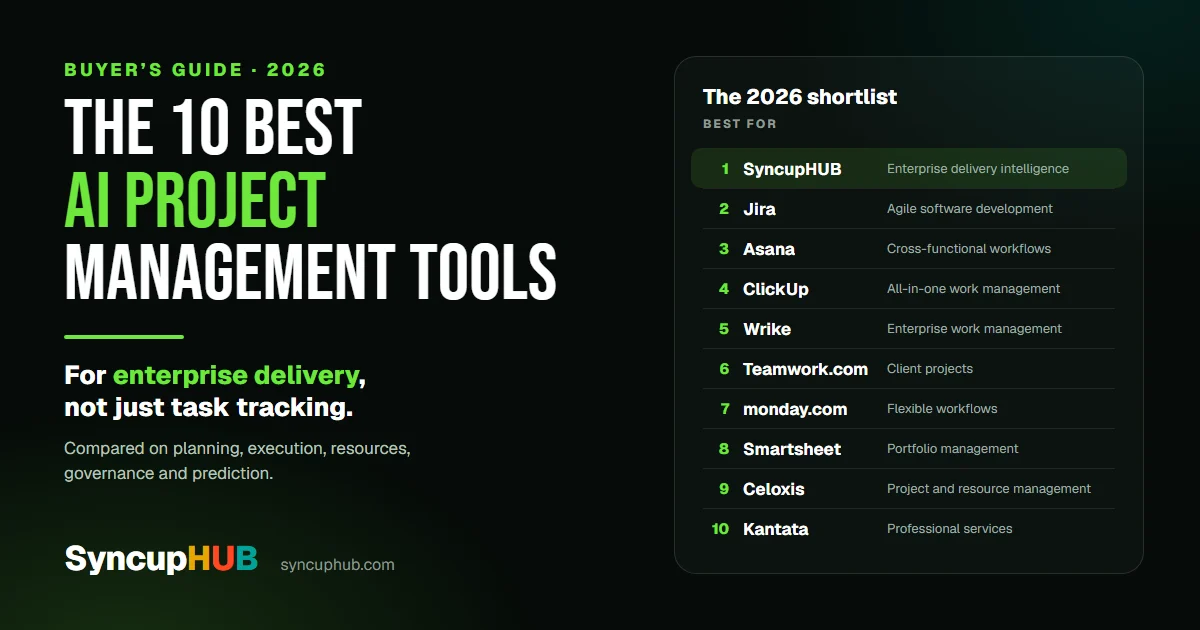
The 10 best AI project management tools in 2026
| Rank | Platform | Best for |
|---|---|---|
| 1 | SyncupHUB | Enterprise delivery intelligence and AI-governed execution |
| 2 | Jira | Agile software development and AI-assisted engineering |
| 3 | Asana | Cross-functional work and AI workflow automation |
| 4 | ClickUp | All-in-one work management and AI agents |
| 5 | Wrike | Enterprise work management and predictive delivery |
| 6 | Teamwork.com | Client projects, resource management and profitability |
| 7 | monday.com | Flexible work management and AI-powered workflows |
| 8 | Smartsheet | Enterprise portfolio management and structured workflows |
| 9 | Celoxis | Portfolio, project and resource management |
| 10 | Kantata | Professional services and resource-centric delivery |
The right platform depends heavily on your organization, delivery model and technology ecosystem.
What makes an AI project management platform enterprise-ready?
Before comparing individual platforms, it is worth defining what “enterprise-ready” actually means. An enterprise project-management platform should go beyond task tracking. We recommend evaluating six dimensions.
1. AI-assisted planning
Can AI transform requirements, objectives or requests into structured projects, work items, dependencies and plans?
2. Intelligent execution
Can the platform monitor delivery, identify blockers and recommend or initiate corrective actions?
3. Resource intelligence
Can leaders understand capacity, utilization, skills, workload and future resource requirements?
4. Business visibility
Can executives connect project execution to strategic goals and measurable KPIs?
5. AI governance
Can an organization control which AI capabilities are used, what information they can access and who is accountable for their outcomes?
6. Predictive intelligence
Can the platform identify risks before they become visible as missed deadlines?
This broader definition matters because enterprise delivery is not simply a collection of tasks. It is a system involving strategy, people, technology, processes, dependencies, resources, risks and business outcomes.
1. SyncupHUB — best for enterprise delivery intelligence
Best for: Organizations looking to connect strategy, execution, workforce intelligence, KPIs and AI governance.
Standout concept: AI delivery intelligence.
SyncupHUB takes a different approach to AI project management. Instead of treating the project as the center of the system, it connects the broader enterprise delivery chain:
Strategy → Product → Program → Project → Sprint → Delivery → Governance → Executive Decisions
The objective is to move beyond conventional task management toward a measurable enterprise delivery operating system. SyncupHUB combines project management, Agile delivery, executive reporting, workforce intelligence and AI capabilities into a unified environment.
Key capabilities
- AI-assisted requirements and project analysis
- Persona-based AI capabilities
- AI skills and agent marketplace
- Resource and workforce intelligence
- Sprint and backlog management
- Jira synchronization
- Executive delivery cockpit
- KPI and contribution intelligence
- Delivery-risk analysis
- Dependency management
- Quality intelligence
- Governance workflows
- Private AI-oriented architecture
- Delivery Digital Twin
One of the more interesting ideas is the AI Skills Marketplace. Instead of allowing employees to independently discover and use disconnected AI tools, organizations can establish governed AI skills with defined ownership, permissions, data access and intended outcomes.
This introduces an important enterprise question:
Who is accountable when an AI skill produces the wrong result?
SyncupHUB’s approach is to make AI ownership visible throughout the skill lifecycle, with organizational guardrails combined with named business ownership for individual use cases.
Why SyncupHUB stands out
Traditional project-management software generally starts with work. SyncupHUB aims to start with business value and trace it through execution.
That makes it particularly interesting for organizations managing large portfolios, programs, Agile teams and complex organizational structures.
Best choice if: You want an AI-powered enterprise delivery platform rather than simply an AI-enhanced task-management application.
2. Jira — best for Agile software development
Best for: Software-development organizations already using the Atlassian ecosystem. Visit Jira
Jira remains one of the strongest choices for Agile software development.
Its AI capabilities have expanded substantially through Atlassian’s Rovo technology. Rovo can search work items using natural language, translate natural-language requests into JQL and create automation flows (Atlassian Support).
Jira’s current direction is particularly notable because AI is moving closer to the execution layer. Atlassian describes a model in which AI agents can receive work and use organizational context from the Teamwork Graph to help execute projects (Atlassian).
Strengths
- Agile boards
- Scrum and Kanban
- Backlog management
- Software-development workflows
- Developer ecosystem
- Large integration ecosystem
- AI-powered work search
- AI automation
- AI-assisted development
Limitation
Jira’s strength is also its defining characteristic: it is deeply optimized around software development.
Organizations looking for a broader enterprise operating layer covering workforce intelligence, business KPIs and cross-functional delivery may need additional platforms or integrations.
Best choice if: Your organization is primarily engineering-centric and already invested heavily in Atlassian.
Already on Jira? See how SyncupHUB works alongside it.
3. Asana — best for cross-functional AI workflows
Best for: Marketing, operations, IT, product and cross-functional teams. Visit Asana
Asana has moved beyond traditional task management with AI Studio and AI Teammates.
AI Studio allows organizations to build AI-powered workflows for activities such as intake, classification, routing, alerts and reporting (Asana).
Asana also increasingly positions AI agents as participants in workflows rather than simply chat assistants.
Its AI capabilities can support project planning, risk reviews, research and reporting while respecting project context and permissions (Asana).
Strengths
- Excellent usability
- Goal and project management
- Cross-functional workflows
- AI workflow automation
- AI agents
- Strong integrations
- Structured work management
Limitation
Asana is excellent at connecting teams and workflows, but organizations looking for a highly specialized enterprise delivery intelligence layer may still require additional portfolio, workforce or governance capabilities.
Best choice if: You need an easy-to-adopt platform for cross-functional teams and want to progressively introduce AI automation.
Weighing Asana for software delivery? See SyncupHUB vs Asana.
4. ClickUp — best for all-in-one AI work management
Best for: Organizations wanting tasks, documents, dashboards, communication and AI in one workspace. Visit ClickUp
ClickUp has made AI a central part of its product strategy.
Its current AI capabilities include ClickUp Brain and Super Agents. ClickUp describes Brain as an AI layer that works across tasks, documents, conversations and other workspace context (ClickUp Help).
Its AI agents can support activities such as backlog prioritization, blocker identification, resource allocation, sprint planning and risk assessment (ClickUp).
Strengths
- Broad feature set
- Highly customizable
- Documents and tasks in one environment
- AI agents
- AI-generated content
- Resource planning
- Dashboards
- Workflow automation
Limitation
The breadth of functionality can create complexity for large organizations that require standardized operating models.
Best choice if: You want a highly flexible all-in-one workspace with rapidly expanding AI capabilities.
Weighing ClickUp for software delivery? See SyncupHUB vs ClickUp.
5. Wrike — best for enterprise work management
Best for: Large organizations managing complex projects, approvals and portfolios. Visit Wrike
Wrike has positioned AI around enterprise work management, predictive insights and increasingly autonomous workflows.
Its 2026 positioning emphasizes AI agents, predictive analytics, resource allocation and enterprise guardrails (Wrike).
Wrike’s enterprise orientation is particularly strong around complex workflows where multiple teams, approvals and dependencies need to be coordinated.
Strengths
- Enterprise work management
- Portfolio visibility
- Resource management
- Workflow automation
- Risk intelligence
- Approval workflows
- Enterprise governance
Limitation
Wrike can be more platform-heavy than simpler work-management products, particularly for teams that want a lightweight user experience.
Best choice if: You have complex enterprise workflows and need strong governance and portfolio-level control.
6. Teamwork.com — best for client projects and profitability
Best for: Agencies, professional-services organizations and teams delivering client work. Visit Teamwork.com
Teamwork.com has taken a particularly focused approach to AI project management.
Its TeamworkAI capabilities include project setup, resource management, scheduling and profitability forecasting (Teamwork.com).
The company’s 2026 comparison of AI project-management platforms emphasizes client delivery, resource planning and profitability as key differentiators (Teamwork.com).
Strengths
- Client project management
- Resource planning
- Time management
- Profitability visibility
- Project setup automation
- Forecasting
- Professional services workflows
Limitation
Its strongest differentiation is around client work and professional services, making it less directly targeted at every type of enterprise delivery organization.
Best choice if: Project profitability, client delivery and resource utilization are central to your business model.
7. monday.com — best for flexible AI workflows
Best for: Organizations wanting visual work management with flexible workflows. Visit monday.com
monday.com has expanded from visual work management into an AI-powered work platform.
Its AI capabilities increasingly include AI agents that can handle planning, status updates, risk identification and reporting (monday.com).
This makes monday.com attractive for organizations where workflows differ significantly between departments.
Strengths
- Highly visual interface
- Flexible workflows
- Dashboards
- Automation
- AI agents
- Cross-department use cases
- Broad adoption
Limitation
The flexibility that makes monday.com attractive can also create governance challenges in very large organizations if teams build significantly different operating models.
Best choice if: You want a flexible, visual platform that can adapt to many departments.
8. Smartsheet — best for enterprise portfolio management
Best for: Enterprises managing structured portfolios, operational workflows and complex planning. Visit Smartsheet
Smartsheet combines spreadsheet familiarity with enterprise work management.
Its current AI platform includes Smart Agents, Smart Flows, Smart Columns and AI data analysis. Smartsheet positions these capabilities around planning, risk detection, workflow automation and portfolio-level visibility (Smartsheet).
The platform also emphasizes enterprise governance and integrations with systems such as Microsoft 365, Google Workspace, Jira and Power BI.
Strengths
- Portfolio management
- Structured data
- Enterprise dashboards
- Resource management
- AI agents
- Workflow automation
- Governance
- Integrations
Limitation
Teams looking for a deeply Agile-native or software-engineering-oriented environment may find other platforms more specialized.
Best choice if: You need enterprise portfolio management with structured data and strong workflow governance.
9. Celoxis — best for project and resource management
Best for: Organizations focused on project portfolio, resource and capacity management. Visit Celoxis
Celoxis has traditionally focused heavily on enterprise project portfolio management, making it relevant for organizations managing many simultaneous initiatives.
The platform is particularly useful where project planning, dependencies, budgets, resource allocation and portfolio visibility need to work together.
Strengths
- Project portfolio management
- Resource planning
- Capacity management
- Financial visibility
- Project dependencies
- Enterprise reporting
Limitation
Compared with newer AI-first platforms, organizations should carefully evaluate the depth of AI agents, autonomous workflows and generative AI capabilities against their specific requirements.
Best choice if: Portfolio and resource management are more important than having the newest AI-agent experience.
10. Kantata — best for professional services resource intelligence
Best for: Professional-services organizations managing people, projects, capacity and financial performance. Visit Kantata
Kantata focuses strongly on professional-services management.
For services organizations, project success isn’t only about finishing work. It also involves utilization, capacity, margins, forecasting and matching skills to demand.
That makes resource intelligence a central consideration when evaluating the platform.
Strengths
- Resource management
- Professional-services workflows
- Capacity planning
- Financial management
- Project delivery
- Portfolio visibility
Limitation
Organizations primarily looking for product-development Agile workflows or broad enterprise AI-agent ecosystems may want to compare Kantata with more general-purpose AI work-management platforms.
Best choice if: Your organization sells professional services and resource utilization is a critical business KPI.
AI project management tools compared
| Platform | Primary strength | AI direction | Enterprise fit |
|---|---|---|---|
| SyncupHUB | Delivery intelligence | Persona AI, skills, predictive delivery | ★★★★★ |
| Jira | Agile software delivery | Rovo, agents, automation | ★★★★★ |
| Asana | Cross-functional work | AI Studio, AI Teammates | ★★★★★ |
| ClickUp | All-in-one workspace | Brain, Super Agents | ★★★★☆ |
| Wrike | Enterprise work management | AI agents, predictive intelligence | ★★★★★ |
| Teamwork.com | Client delivery | Project, resource and profitability AI | ★★★★☆ |
| monday.com | Flexible workflows | AI agents and automation | ★★★★☆ |
| Smartsheet | Portfolio management | Smart Agents and AI analysis | ★★★★★ |
| Celoxis | PPM and resource management | AI capabilities evolving | ★★★★☆ |
| Kantata | Professional services | Resource and delivery intelligence | ★★★★☆ |
The ratings above are editorial fit ratings, not vendor scores. Organizations should validate capabilities against their own security, integration, AI-governance and workflow requirements.
What is the difference between AI project management and AI delivery intelligence?
This may become one of the most important distinctions in enterprise software.
Traditional project management asks:
Are we on schedule?
AI project management asks:
What is likely to happen next?
AI delivery intelligence asks:
What should the organization do next to maximize the probability of achieving the desired business outcome?
That is a significant evolution. Consider a product launch.
A traditional project-management system might tell an executive: Product Launch: 72% complete.
An AI project-management system might say: Launch is at risk because testing is 5 days behind schedule.
An AI delivery-intelligence system should ideally go further:
Testing is five days behind. Two critical dependencies are unresolved. The assigned QA capacity is below forecasted demand. Moving one qualified resource from Program B could reduce projected launch delay from seven days to two days. Executive approval is required.
That is the difference between reporting and decision intelligence.
The rise of AI agents in project management
Another major change in 2026 is the movement from AI assistants toward AI agents.
An assistant waits for a prompt. An agent can monitor a situation, reason about what needs to happen and execute an approved workflow. For example:
Traditional workflow
Project manager:
- 1Check project status
- 2Review overdue tasks
- 3Identify blockers
- 4Contact owners
- 5Update report
- 6Escalate issues
- 7Schedule follow-up
Agentic workflow
AI agent:
- 1Monitor delivery signals
- 2Detect abnormal delay
- 3Identify dependency
- 4Analyze impact
- 5Notify responsible owner
- 6Prepare escalation
- 7Update project status
- 8Request human approval where required
Platforms such as Asana, ClickUp, monday.com and Jira are already moving in this direction (Asana).
The important enterprise requirement is therefore not simply “Does the platform have AI agents?” It is “Can the organization govern those agents?”
Why AI governance matters in project management
As organizations introduce AI into project delivery, governance becomes unavoidable.
Consider an AI skill that automatically analyzes requirements. Who decides:
- What data can it access?
- Who can use it?
- Which model does it use?
- Who can modify it?
- Who approves the modification?
- What happens when the output is incorrect?
- Who owns the business outcome?
- How is its effectiveness measured?
This is why AI governance should become part of project-management architecture. A mature enterprise model should combine:
- Central AI governance
- Security and administration
- Business ownership
- AI skill lifecycle management
- Human review
- Outcome measurement
This is an area where the emerging AI project-management market still has substantial room to evolve.
How to choose the right AI project management platform
There is no universal winner. Instead, start with your organization’s primary problem.
Choose SyncupHUB if…
You want to connect strategy, projects, people, KPIs, governance, AI and executive decisions, and are looking for an emerging enterprise delivery-intelligence model.
Choose Jira if…
Your organization is heavily focused on software engineering, Agile development and the Atlassian ecosystem.
Choose Asana if…
Cross-functional workflows, goals and ease of adoption are priorities.
Choose ClickUp if…
You want an extremely broad all-in-one workspace with rapidly expanding AI capabilities.
Choose Wrike if…
You need sophisticated enterprise workflows, approvals, resource management and portfolio visibility.
Choose Teamwork.com if…
Your business revolves around client delivery, profitability and professional services.
Choose monday.com if…
Flexibility and visual workflow management are your highest priorities.
Choose Smartsheet if…
You need structured portfolio management, enterprise workflows and strong governance.
Choose Celoxis if…
Project portfolio and resource management are your primary requirements.
Choose Kantata if…
You operate a professional-services business where people, capacity and financial performance are tightly connected.
The future of enterprise project management
The biggest change may not be AI-generated project plans. It may be the gradual disappearance of the traditional boundary between project management, resource management, business intelligence, AI agents, workforce intelligence and executive decision-making.
These systems are increasingly converging. The project-management platform of the future will not simply tell an executive what happened. It will understand:
- What the organization wants to achieve
- What work is required
- Who can perform it
- What resources are available
- What dependencies exist
- Where risk is emerging
- Which AI capabilities can help
- What business outcome is likely
- What decision should be made next
That represents a fundamental shift:
From project tracking to intelligent enterprise delivery.
Final verdict: which AI project management tool is best in 2026?
There is no single platform that is best for every organization.
- Jira remains a powerful choice for Agile software development.
- Asana is strong for cross-functional work and AI workflow automation.
- ClickUp stands out for breadth and AI-powered all-in-one work management.
- Wrike is compelling for complex enterprise workflows.
- Teamwork.com is particularly strong for client-service organizations.
- monday.com offers highly flexible AI-enabled workflows.
- Smartsheet is well suited to structured enterprise portfolio management.
- Celoxis and Kantata remain relevant where portfolio, resource and professional-services management are central.
And SyncupHUB represents a different direction: an attempt to move beyond AI-assisted project management toward AI-powered enterprise delivery intelligence.
The fundamental question for enterprises is therefore changing. It is no longer:
Which project-management tool has the best AI?
The more important question is:
Which platform can turn AI, people, projects, data and strategy into measurable business outcomes?
That is likely to be the defining battleground for enterprise project-management software over the next several years.
Frequently asked questions
What is AI project management software?
AI project-management software uses artificial intelligence to assist or automate activities such as project planning, task creation, scheduling, reporting, resource management, risk identification, workflow automation and decision support.
What is the best AI project management tool in 2026?
There is no universal answer. The best platform depends on the organization’s requirements. Jira is particularly strong for software development, Asana for cross-functional workflows, ClickUp for all-in-one work management, Wrike for complex enterprise work, and SyncupHUB for an emerging enterprise delivery-intelligence model.
Can AI replace project managers?
AI can automate significant amounts of administrative and coordination work, but project managers remain important for judgment, stakeholder management, prioritization, leadership, negotiation and accountability. The more realistic future is project managers working with AI agents, rather than AI simply replacing project managers.
What should enterprises look for when buying AI project management software?
Look beyond AI chat features. Evaluate AI planning, agent capabilities, resource intelligence, predictive risk management, integrations, security, governance, data permissions, auditability, portfolio visibility and measurable business outcomes.
Is AI project management secure?
Security varies by vendor and deployment model. Enterprises should examine data processing, model providers, retention, training policies, permissions, encryption, audit controls and AI governance before deployment.
What is AI delivery intelligence?
AI delivery intelligence extends beyond task automation. It connects strategy, execution, people, resources, KPIs, risks and business outcomes to help organizations make better delivery decisions.
Features in this article
- Delivery Digital TwinA live model of the delivery that forecasts the release and tests a change before you commit to it.
- Leadership CockpitPortfolio health, programmes at risk and the decisions waiting on you, read from the live delivery.
- QA IntelligenceAI-drafted test cases from acceptance criteria, approved by QA and traced to the requirement.
- AI Agents for Every RoleSeventeen persona agents and 59 sub-agents, all reading the same delivery model.
- AI and Tools MarketplaceThe AI models and delivery tools your teams may use, from in-tenant models to the OpenAI and Claude APIs, each approved by an administrator.
SyncupHUB runs this inside your own tenant — a delivery model that reads the signal as it forms, with an agent for every role.
- The 10 best AI project management tools in 2026
- What makes an AI project management platform enterprise-ready?
- 1. SyncupHUB — best for enterprise delivery intelligence
- 2. Jira — best for Agile software development
- 3. Asana — best for cross-functional AI workflows
- 4. ClickUp — best for all-in-one AI work management
- 5. Wrike — best for enterprise work management
- 6. Teamwork.com — best for client projects and profitability
- 7. monday.com — best for flexible AI workflows
- 8. Smartsheet — best for enterprise portfolio management
- 9. Celoxis — best for project and resource management
- 10. Kantata — best for professional services resource intelligence
- AI project management tools compared
- What is the difference between AI project management and AI delivery intelligence?
- The rise of AI agents in project management
- Why AI governance matters in project management
- How to choose the right AI project management platform
- The future of enterprise project management
- Final verdict: which AI project management tool is best in 2026?
- Frequently asked questions
Keep reading
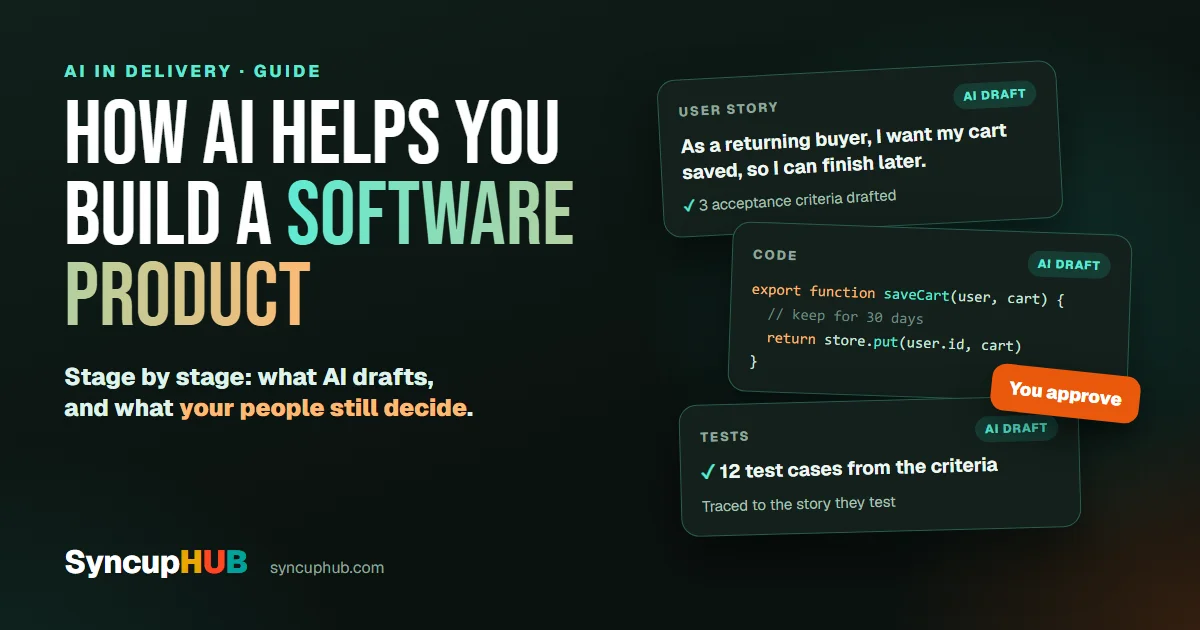
How AI helps you build a software product, stage by stage
Where AI genuinely helps in software product development, from discovery and requirements to code, tests and release, and what your people should still own.
AI software that actually saves you time in 2027
The AI tools that genuinely save hours, from meeting notes to code, task by task, and a simple test for spotting the ones that only add work.