AI Product Owner: turn requests into decisions
How SyncupHUB’s PO Agent checks request clarity, reviews product fit and drafts acceptance criteria, while product owners still own priority and approval.
Short answer
What does an AI product owner do?
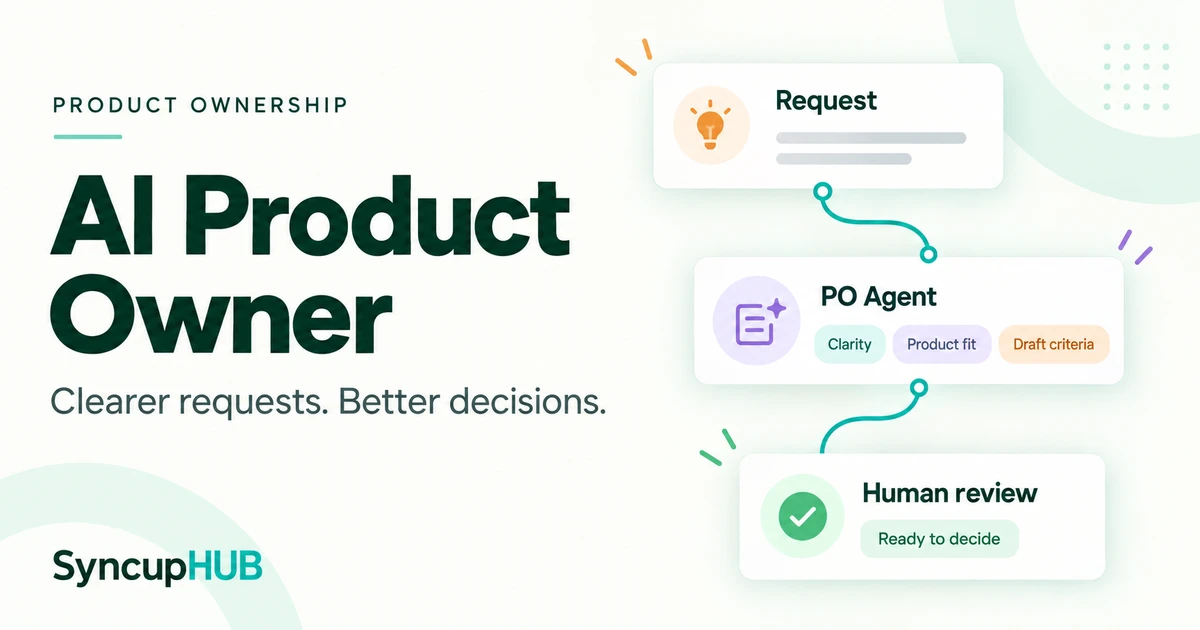
An AI product owner is an assistant for the product ownership workflow. In SyncupHUB the PO Agent checks incoming requests, drafts requirements and acceptance criteria, and surfaces the gaps for a person to resolve. The product owner stays accountable for priority, approval and the outcome.
A product owner can begin the day with a customer request, an urgent stakeholder message and a backlog full of work that sounded important last month. Before deciding what comes next, someone has to establish what each request means, what evidence supports it and what the team still needs to learn.
An AI Product Owner assistant can help prepare those decisions. In SyncupHUB, that role is served by the PO Agent: it checks incoming requests, drafts requirements and acceptance criteria, and surfaces gaps for a person to resolve. The product owner remains accountable for the outcome.
What an AI Product Owner actually does
Here, “AI Product Owner” means an assistant supporting the product ownership workflow. It helps turn scattered inputs into something a product owner can review: a clearer problem, a proposed requirement, questions that need answers and a draft definition of success.
The useful output is a decision brief. Who needs this? What problem are they experiencing? Does the request fit the product? Is related work already in the backlog? What would acceptance look like? An answer without evidence should remain an assumption or an open question.
The agent prepares the decision. The product owner owns the commitment.
Five ways the SyncupHUB PO Agent helps
The PO Agent is shaped around the work that happens before a request reaches a delivery team. Its responsibilities include:
- Check request clarity: identify missing information about the problem, intended users, scope or desired outcome.
- Review product fit: surface questions about how a request relates to the product’s purpose and existing direction.
- Check possible backlog overlap: flag related work for review before the same need becomes another ticket.
- Draft requirements and acceptance criteria: prepare a structured starting point that a product owner can edit and validate.
- Flag readiness and priority trade-offs: make unresolved questions and competing considerations visible before planning.
These are proposals. A possible duplicate still needs comparison. A draft requirement still needs validation. A readiness assessment still depends on the information available to the agent.
A practical example: “We need an export button”
Consider an illustrative request: “Add an export button so account managers can send customers their monthly usage.” The feature sounds straightforward, but the request leaves several product decisions unresolved.
- Which account managers may export which customer’s data?
- What information should the file contain, and which fields must be excluded?
- Does “monthly” mean a calendar month, billing period or selected date range?
- Is a report or export capability already available elsewhere in the product?
- What problem does the customer need the file to solve?
The PO Agent’s role is to help expose gaps like these and prepare a draft from the answers. It should not quietly choose a file format, invent a customer preference or turn an unknown permission rule into a requirement.
Once the scope is agreed, draft acceptance criteria for this example might say: the export includes only the selected customer and period; an unauthorised user cannot generate the file; and an empty result is explained clearly. These are review examples, not claims about a shipped SyncupHUB export feature.
The product owner validates the customer need and scope. Engineering reviews feasibility and estimates the work. QA challenges whether the criteria can be tested. The draft becomes useful through that review.
Use AI to explain priority trade-offs
A polished story is not automatically the next story to build. Priority also depends on customer value, strategic fit, dependencies, timing and what the team would postpone to take it on.
Ask for the reasoning behind a recommendation. Which evidence supports the customer impact? Which dependency could change the sequence? What is still unknown? What would make the product owner choose differently? Those questions turn a proposed order into a conversation the team can evaluate.
Keep estimates and delivery commitments with the people doing and owning the work. The PO Agent can flag trade-offs; it cannot supply missing evidence by presenting a more confident answer.
Keep human ownership explicit
SyncupHUB’s agents propose work for human review. Make that boundary practical by naming who decides each part of the request:
- The product owner validates the problem, sets the priority and accepts or rejects proposed scope.
- The delivery team reviews feasibility, dependencies and estimates before making commitments.
- QA reviews acceptance criteria and the evidence needed to demonstrate that the requirement was met.
- The relevant business owner resolves policy, access and customer commitments that the request depends on.
For the wider approval model, read who approves what your AI just did. AI providers are also a deliberate choice: administrators approve the models and tools available through the AI and tools marketplace.
Keep the reasoning connected to delivery
The PO Agent sits within a wider workspace. Use Visual Canvas to explore the journey and link ideas to real work. Keep agreed requirements, comments and approvals in Document Spaces. Use requirement traceability to follow the requirement through delivery evidence.
Those connections help later reviewers recover why an item exists and what was agreed. For a walkthrough of the complete intake process, including the product film, see from business request to backlog.
Measure the quality of the handoff
For a small trial, choose one stream of incoming requests and record a baseline before introducing the agent. Suggested measures include:
- Time from receiving a request to having a reviewable draft.
- Clarification questions that still reach engineering after refinement.
- Proposed duplicate matches that a product owner confirms or rejects.
- Acceptance criteria that reviewers need to rewrite substantially.
- Requirements reopened because the original need or scope was misunderstood.
Review the rejected suggestions as carefully as the accepted ones. Faster drafting is useful when it improves the handoff; a growing queue of unreviewed stories is simply more work waiting for attention. These are evaluation measures, not promised performance results.
Start with one real product decision
Take a request your team is currently struggling to refine. Bring the source material, the known constraints and any related backlog items. Review the PO Agent’s proposed requirement, challenge its assumptions and decide what evidence is still missing.
That is a useful test of an AI Product Owner: whether it helps the responsible people make a clearer decision and prepare work the team can understand. Explore SyncupHUB’s AI agents or request a walkthrough to see that process with your own delivery context.
Features in this article
- Visual CanvasSticky notes, flows and architecture on one board, with every shape linked to real work.
- Document SpacesDocuments with comments, approvals and version history, kept next to the stories they govern.
- Requirement to Code TraceabilityFollow a requirement to the code that shipped it, and recover requirements from code that exists.
- AI Agents for Every RoleSeventeen persona agents and 59 sub-agents, all reading the same delivery model.
- AI and Tools MarketplaceThe AI models and delivery tools your teams may use, from in-tenant models to the OpenAI and Claude APIs, each approved by an administrator.
SyncupHUB runs this inside your own tenant — a delivery model that reads the signal as it forms, with an agent for every role.
- 01What an AI Product Owner actually does
- 02Five ways the SyncupHUB PO Agent helps
- 03A practical example: “We need an export button”
- 04Use AI to explain priority trade-offs
- 05Keep human ownership explicit
- 06Keep the reasoning connected to delivery
- 07Measure the quality of the handoff
- 08Start with one real product decision
Keep reading
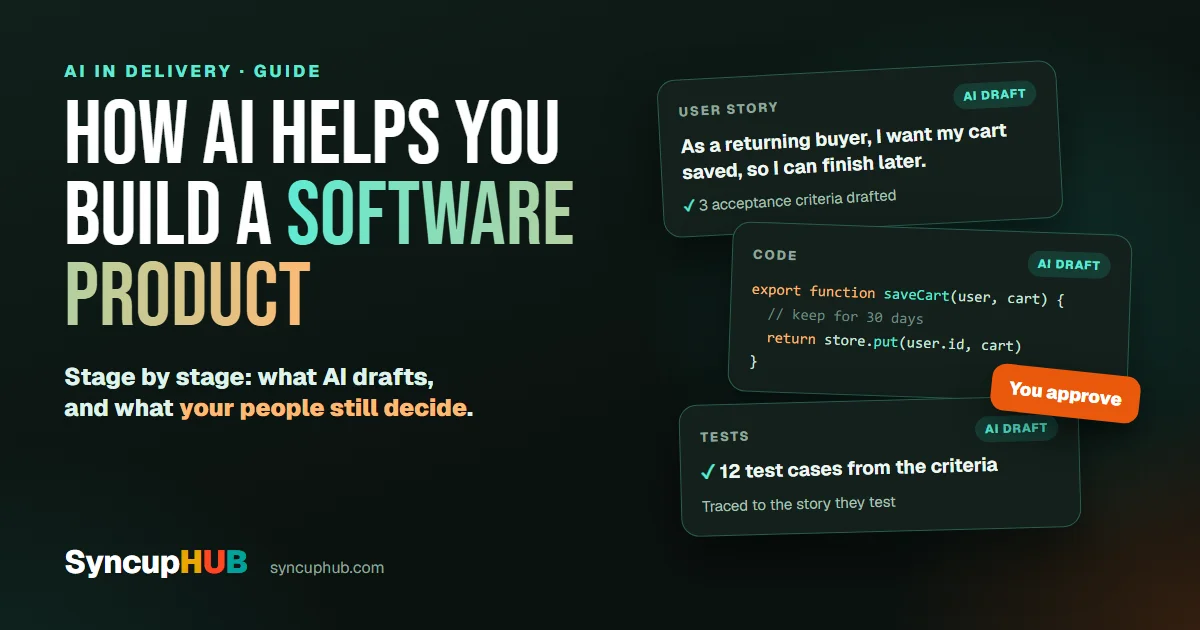
How AI helps you build a software product, stage by stage
Where AI genuinely helps in software product development, from discovery and requirements to code, tests and release, and what your people should still own.
AI software that actually saves you time in 2027
The AI tools that genuinely save hours, from meeting notes to code, task by task, and a simple test for spotting the ones that only add work.