You bought all five letters. Can you answer one question?
AI, BI, Cloud, Data and Engineering are five budget lines in most enterprises and one capability in almost none. The value is not in owning the letters — it is in the order you built them and the seams where they meet.
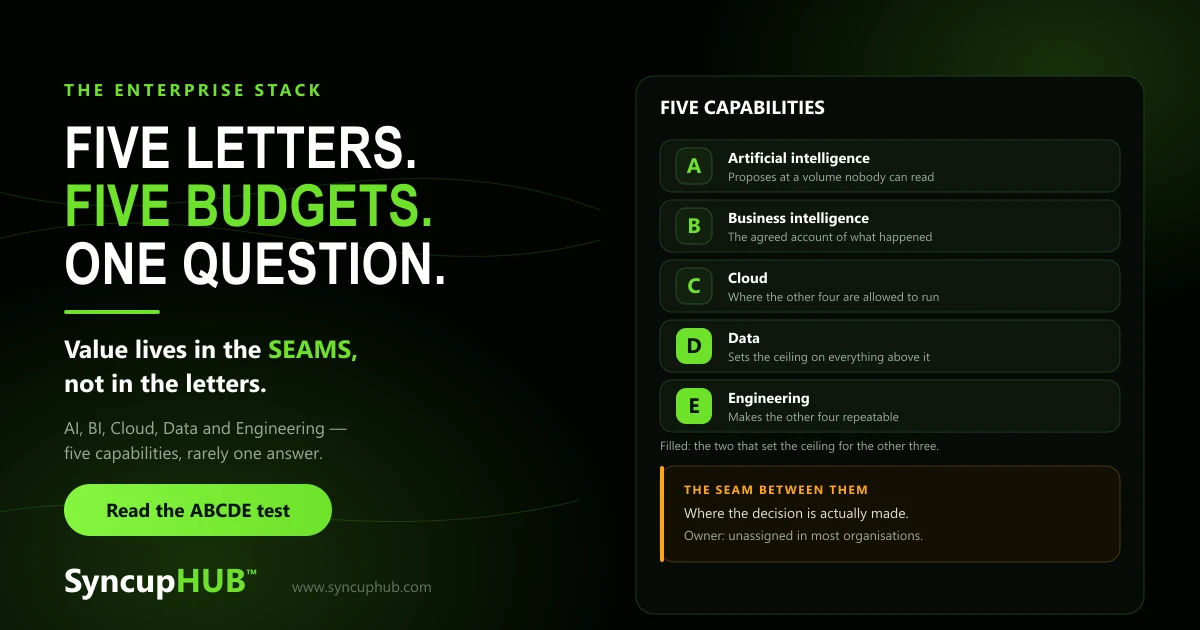
Almost every enterprise now owns all five: an AI programme, a BI platform, a cloud estate, a data function and an engineering organisation. Five capabilities, five budget lines, five sets of people who are genuinely good at their part.
And still, when a delivery date moves, it takes three weeks and four meetings to find out why.
Five letters, five budgets, one org chart
The letters are usually drawn as a stack, bottom-up: cloud at the base, data above it, engineering alongside, BI on top and AI crowning the diagram. It is a tidy picture, and it describes almost nobody’s reality.
What organisations actually have is five columns. Each has a leader, a roadmap, a vendor relationship and a set of metrics it is judged on. Each is defensible on its own terms. The AI programme can show adoption. The BI team can show dashboard usage. The cloud team can show uptime and spend. Data can show pipelines delivered. Engineering can show throughput.
Every one of those numbers can be green in the same quarter that a flagship programme slips by a month. Nobody is lying. The reporting is simply organised by column, and the failure was not.
A capability nobody owns end to end is not a capability. It is five things that happen to be in the same building.
Most organisations bought them in the wrong order
The letters are alphabetical, not sequential. But the order most enterprises buy them in is close enough to alphabetical to cause real damage.
AI goes first, because it is the one the board asks about. BI is usually already there, five years old and reporting on last quarter. Cloud is a migration that finished, or nearly finished. Data gets a function and a strategy document. Engineering discipline is assumed rather than funded.
The dependency runs the other way. An AI answer is capped by the data it can read. The data is capped by the engineering habits that produce it. Both are capped by where the cloud estate lets them run, and how quickly that can be changed.
Build the top of the stack first and you get pilots that demo beautifully and never reach production — not because the model was wrong, but because nothing underneath it was ready to be asked a question. This is the most expensive ordering mistake in enterprise technology, and it is nearly always made in good faith.
What each letter is actually for
Stated plainly, without the vendor framing, each letter does one job:
- A — AI applies judgement at a volume no person can read. It is a proposal engine, not an authority.
- B — BI produces the agreed account of what already happened. Its value is that everybody accepts the number, not that the number is new.
- C — Cloud decides where the other four are allowed to run, how quickly they can be changed, and what they cost to keep running.
- D — Data is the substrate. It sets the ceiling on everything above it, and nothing above it can raise that ceiling.
- E — Engineering is the discipline that makes the other four repeatable. It is the least fashionable letter and the one that decides whether any of the others survive a second year.
Read the list again and notice which two tend to get the smallest budgets — and which two everything else rests on.
The value is in the seams, and the seams have no owner
BI will tell you a milestone slipped. AI will tell you which milestones look likely to slip next. Neither tells you what to do about it, who is doing it, or by when.
That gap is not a tooling gap. It is a seam — the place where one capability’s output has to become another’s input. In most organisations the seam is a person copying a number out of one system into a slide, adding an interpretation nobody else can see, and sending it to a committee that meets on Thursday.
The seams are where the compounding value sits, and they are the only part of the stack nobody has been given. There is a Head of Data and a Head of Engineering, and quite often now a Head of AI. There is rarely anybody accountable for the sentence that has to travel between them.
BI answers what happened. Something has to own what happens next.
A dashboard is a rear-view mirror at excellent resolution. That is not a criticism. An agreed record of the past is genuinely hard to produce, and most organisations took years to get one they trust.
But a delivery decision is made about the future, under time pressure, on incomplete information. The useful question is not what our velocity was last sprint. It is which commitments break if this dependency lands two weeks late, and what is the cheapest thing we can change today.
Answering that needs a model of the work rather than a report on it — capacity, dependencies, readiness and history held as one system you can put a question to, rather than five extracts reconciled by hand the night before the review.
And the answer has to arrive as a proposal a person can accept, amend or reject, with the evidence attached. An answer nobody can interrogate is not decision support. It is a second opinion with better formatting.
Data quality is an engineering habit, not a data project
Every organisation that has run a data quality programme has learned the same thing: the defects are not created in the data layer. They are created upstream, by the systems and the people that produce the records. The data team then spends its life correcting downstream what was never captured properly at source.
Which is why D and E are not really two letters. A field that is optional in a form is a null in a warehouse, and no amount of cleansing invents what nobody was asked to enter. A dependency recorded as free text in a comment is invisible to every layer above it, however sophisticated that layer becomes.
You cannot fix D with a D project. Data quality is decided at the moment of capture, by the people who designed the capture.
The practical consequence is unglamorous. If you want the AI layer to be worth its licence, make the required fields required, keep work items linked to the things they belong to, and stop accepting prose where a relationship was meant to go. That is a fortnight of engineering decisions, and it raises the ceiling on everything above it.
What all five working together looks like on an ordinary Tuesday
Not a transformation programme. A Tuesday.
A dependency on an integration team is flagged as at risk. The link exists to be flagged because engineering discipline made it mandatory when the story was created — that is E. How long similar dependencies actually took is available because it was captured rather than reconstructed afterwards — that is D. The same pattern is visible across four programmes because the reporting layer agrees with itself — that is B. All of it runs somewhere elastic enough that asking a question of it does not require a capacity request — that is C.
And the proposal — move the commitment, split the scope, or escalate now rather than at the checkpoint — is drafted with its reasoning shown, by A.
A person then decides. That is the whole design. Four letters prepare, one letter proposes, and a human commits with their name against the commitment.
One test, and it takes an afternoon
There is a single question that establishes whether you have five tools or one capability.
Take a decision your organisation made in the last month — a date that moved, a scope that was cut, an investment that was approved. Now trace it backwards: to the proposal that suggested it, the evidence that supported the proposal, the data that produced the evidence, and the system of record that captured the data.
If you can walk that path in an afternoon, the letters are connected. If the trail goes cold at the second step — and in most organisations it goes cold at the second step — then ABCDE is an inventory of what you have bought, not a description of what you can do.
The useful news is that the fix is rarely another letter. It is almost always the seams between the ones you already own.
Five capabilities on five budget lines is an inventory.
Five capabilities that meet on one decision, with the evidence attached and a person’s name on it, is an organisation that can answer.
SyncupHUB runs this inside your own tenant — a delivery model that reads the signal as it forms, with an agent for every role.
Keep reading
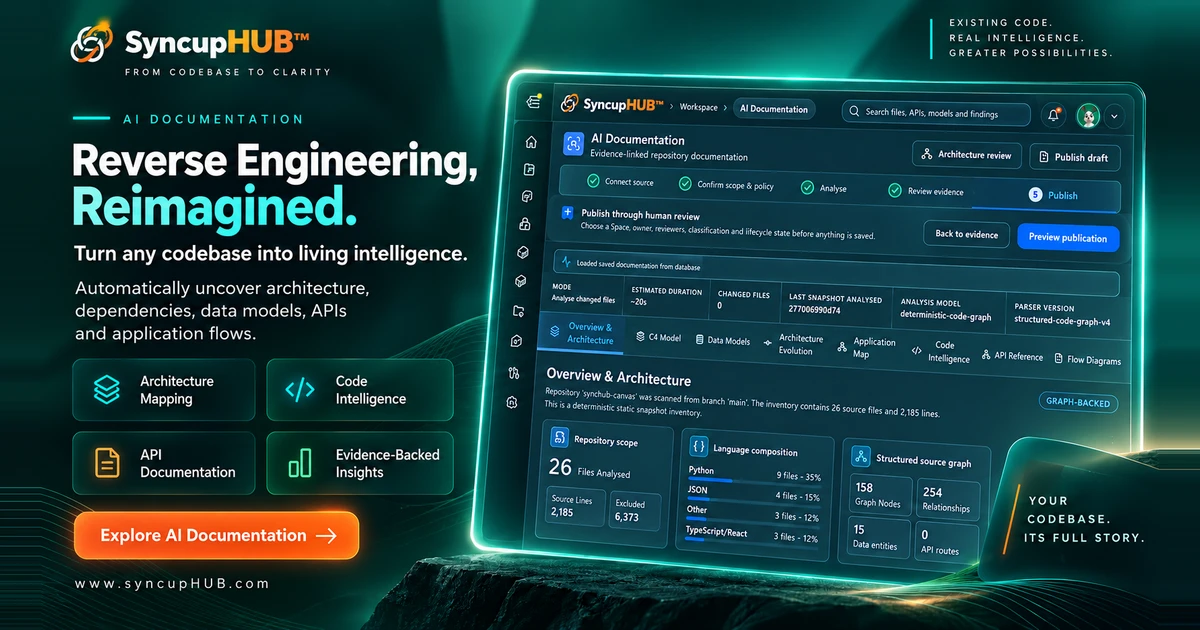
The only person who understood it has left
Documentation is a snapshot of what somebody believed. The repository is a record of what was actually done. Reverse engineering turns existing code into architecture, data models, APIs and flows — with every claim traced back to a line.
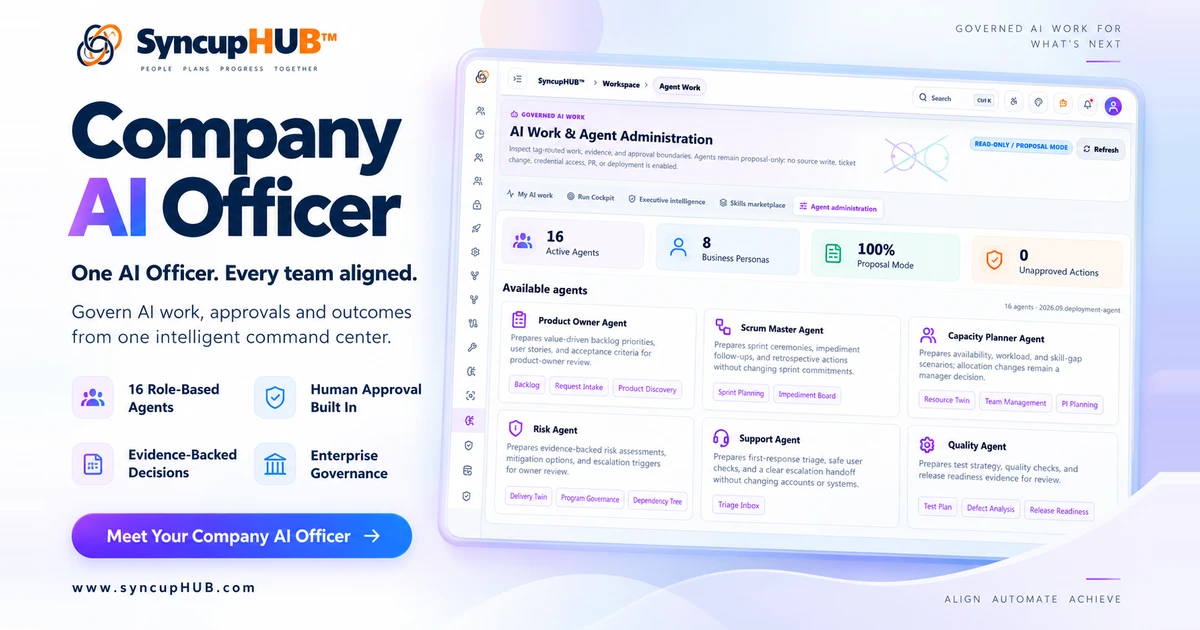
Who approves what your AI just did?
Most AI pilots fail an audit before they fail a business case. Governed AI work means agents that prepare and humans that commit — sixteen role-based agents, proposal-only by design, with every decision reconstructable.